
JERRY FENG researches the history of Chinese Brazilians its ties to the “coolie” trade in Cuba and Peru, and its ultimate demise as a result of opposition from various forces.
Brazil today, like the United States, prides itself as a nation built upon diversity, multiculturalism, and immigration. However, the path from Brazil’s beginning to today was a tragic story of oppression and incremental progress over time. Starting as a settler colonial state for Europeans in 1500, Brazil then began bringing enslaved peoples from Africa and enslaved the Indigenous Brazilians to fund the colonial project for the centuries to come. Beginning in the 1800s towards the late 1900s, Brazil received lots of migrants from Europe, the Middle East, Japan, and China, adding to the already complex societal framework.
Much of this migration began to become an important issue towards the mid to late 18th century when abolitionist movements gained lots of influence. This change in global attitudes towards slavery resulted in the banning of slavery in its last three strongholds in Puerto Rico, Cuba, and Brazil in 1873, 1880, and 1888, respectively. Yet, even decades before, governments began thinking about backup plans for the eventual removal of slavery as an official institution for societal organization and economic growth. Brazil, among many other places in the Americas such as Cuba and Peru, turned to migrant labor in the form of indentured servitude as the perfect solution, especially those from China. Chinese migrants already began arriving in the early 1800s all across the Americas, but it wasn’t until later in the century they nearly became official government policy in Brazil.
While attracting Chinese migrant labor en mass never fully succeeded, the story of Brazil’s attempts to recruit Chinese labor reflected the continuation of the trends of the 1800s that were based on exploitation and rooted in racism. Yet, the small number of Chinese laborers that did make it to Brazil and the later Chinese immigrants in the late 20th century would play an important role in defining Brazilian history and politics.
The very first mention of Chinese migrant laborers in Brazil occurred in 1807 when the Prime Minister of the exiled Portuguese King presented the idea of bringing Chinese workers to Brazil. A few years later between 1810 and 1812, the first arrival of Chinese tea cultivators came to work in Rio de Janeiro’s Royal Botanical Garden at the request of the Portuguese King. The King wanted to get a sense of the international tea market, but the tea-cultivating fascination was soon replaced by the significantly more profitable coffee cultivation. So, from the very beginning of Chinese presence, there was an emphasis and interest in the potential of economic development, especially at a time when the trading of tea, spices, coffee, sugar, and others was of strong economic potential. However, after the Portuguese Court moved back, the fate of these few hundred or so Chinese tea cultivators became unclear, but it is largely believed that they ended up filtering into the rest of Rio’s society. This introduction of Chinese migrant laborers into Brazil became the first official government policy to bring migrant labor to all of Latin America, even if in small numbers to begin with.
Just a few decades after, however, the British — who played a major role in assisting the Portuguese Court’s relocation to Brazil and later in Portuguese internal affairs — began putting pressure to have the Portuguese and Brazilians (independent since 1822) ban the slave trade. Thus, the then-still-Portuguese elite began thinking about alternatives to slave labor to fund their slave-based economy, and one Portuguese Foreign Minister considered importing as many as two million Chinese workers. While seemingly absurd on the surface, this fascination with Chinese immigrant labor did not happen in a vacuum. The British victory against Qing China during the Opium War in 1842 precipitated the first step in opening the Chinese market and people to Western exploitation. From here going forward, there was a continuation of inter-empire and intra-empire communications and networks that led to the decision to try and recruit Chinese laborers, and it largely stemmed from the global pressures to ban the slave trade and slavery.
Brazil’s economy relied heavily on imported slaves; but, after Brazil officially banned the slave trade in 1850, they turned to other options. At the time, Brazil looked to other places in the Americas for inspiration, notably Cuba and Peru, who have both brought over tens of thousands of Chinese laborers to work in their plantations. Specifically, during the agricultural congress of 1878 in Rio, a majority of the representatives of coffee-growing areas further emphasized their desire for the importation of “coolies” — the term used to refer to Chinese migrant laborers then. The Brazilian plantation representatives were displeased at the efficiency of the European migrants and instead wanted cheap, hardworking, and submissive labor who were already adapted to the low standard of living that came with Brazilian agricultural work.
The Brazilian government already began to actively recruit Chinese laborers from the 1850s to the 1870s, specifically from Hong Kong and Macau, thinking the Chinese experiences migrating to Cuba and Peru would translate to Brazil itself. As British and Portuguese colonies, respectively, Hong Kong and Macau would become incredibly important centers for coolie migration to the Americas, and Brazil also had strong ties to both the British and Portuguese. Once again, this reality underscores the inter-empire and intra-empire networks that became a continuity of their world order.
In 1870, the Brazilian government created the Sociedade Importadora de Trabalhadores Asiáticos (Asian Workers Importation Society) to recruit Chinese migrant laborers through 10-year contracts. Members of the Brazilian elite then requested action from the Brazilian Emperor and government to help them negotiate favorable treaties that would bring over cheap Chinese laborers. During this time, China was also struggling internally that somewhat pushed Chinese emigration abroad and encouraged Brazil’s diplomatic action. China experienced numerous internal conflicts during this: Taiping Rebellion (1850–1864), Yunnan Rebellion (1860–1873), and the Xinjiang Revolt (1861–1881) At the same time, China was also fighting conflict after conflict with the French, British, Russian, and German Empires over influence in the weakened Qing Dynasty.
Thus, this type of behavior from Brazil to seek treaty agreements with China was not unlike the trends of the time when European powers took advantage of the weak Qing during its century of humiliation (1842–1949) to negotiate what China calls “unequal treaties.” These unequal treaties gave extraterritorial rights and generous economic benefits among other privileges to European and American people and companies. However, Brazil’s reliance on these networks would also end up backfiring.
Throughout these past few decades, Brazil did not succeed in importing a significant number — no more than just a few thousand — of Chinese laborers to Brazil. By 1872, the official census only counted 436 throughout the entire country. In 1875, Brazil tried again to recruit Chinese workers in Canton, and even in California, but failed to attract many people due to Qing opposition. Specifically, Brazil began facing resistance from the Qing Government itself and its inter-colonial networks with the British and Portuguese. Reports about slave-like conditions of Chinese laborers in Peru and Cuba began spreading, leading to strong condemnation from the abolitionist establishments in the British and Portuguese Empires along with the Qing Dynasty. Ironically, the British, who intervened in Brazilian affairs to end the African slave trade also used Indian and Chinese workers in their colonies in the Caribbean.
Between 1846 and 1874, over 290 thousand Chinese laborers went to Peru, Cuba, and the British, French, and Dutch West Indies. Of those 290 thousand, it is estimated that between 10 and 25% of them died on the way, with the death rate reaching as high as 30% between 1860 and 1863 for those going to Peru. For enslaved Africans who went to Brazil between 1795 to 1811, more than half a century earlier, the estimated death rate was around 9.5%.
Yet, these tragic conditions for Chinese migrant workers did not stop Brazil from continuing its efforts to recruit Chinese workers. Brazil even looked to the United States as a role model for how to recruit Chinese laborers: building upon colonial networks and negotiating one-sided treaties with the Chinese. In 1879, Brazil sent a delegation to China to negotiate a “Treaty of Friendship and Commerce” with an underlying motive to secure the importation of Chinese migrants. The Chinese refused to sponsor any forms of emigration, arguing that emigration should be voluntary; the resulting 1880 Treaty of Friendship and another revised treaty in 1881 ended up not containing any agreements regarding emigration or labor. Met with opposition again and again, Brazil turned to more informal, private contractors to help meet its labor demand.
In 1892, the Brazilian Parliament passed a law permitting Chinese immigration while the Brazilian Senate approved another diplomatic mission to China. This time, Brazilian immigration companies with support from the government went directly to Hong Kong — where most of the early Chinese migrants left — and collaborated with a German steamship called Tetartos. By 1893, the Tetartos managed to bring just under 500 Chinese workers to Brazil, all of whom quickly ended up on Brazilian estates as laborers. However, this pseudo-under-cover plot incited great outrage from the British, Portuguese, and Chinese authorities, which for the last time nailed Brazil’s Chinese labor plans to its coffin. By the mid-1890s, Brazil only had a total of a few thousand Chinese workers, compared to around 45 thousand in Cuba and 60 thousand in Peru. Going forward, Brazil would then look to Japan instead as a substitute for both Chinese and African indentured servitude. The inter-empire networks that initially inspired Brazil to import Chinese immigrants eventually also led to the demise of Brazil’s initiatives.
Throughout this near-century-long initiative to secure Chinese migrant laborers as a substitute for its slave-based economy, Brazil underwent lots of debate over the merits of Chinese migrant labor that often contradicted one another. And, both the proponents and opposition had racial superiority undertones, it was the opposition that most notably had their basis of thought rooted in racist ideology. This debate came to be known as the ‘Chinese Question’.
Proponents of Chinese labor argued that cheap Chinese labor would be economically viable and would secure Brazil a competitive position in the global market. As such, the Chinese would sometimes be referred to as “paragon[s] of virtue.” The opposition, however, had much more varied opinions. The abolitionist side of the opposition was mostly concerned with the de facto slave-like conditions that these workers would face and opposed it on humanitarian grounds. Yet, at the same time, some abolitionist advocates of Chinese immigration would both argue that Chinese labor would help eliminate the slave institution but that their relationship with Brazilian planters would be much like that of a master and a slave regardless.
Another side of the opposition worried that too many coolies would “mongolize” Brazilian society just like how they argued Africans “Africanized” it. Here, the Chinese would then be referred to as “demon[s] of depravity.” Pamphlets and articles opposing Chinese immigration called the Chinese drug addicts, corrupt, weak, and “indolent,” contributing to the global trope of what defined Chinese in the European colonies during this period. In this era of Enlightenment ideals, there was thus a concurrent contradiction between those who took the liberal economic ideas of market capitalism and those who deliberately overlooked their racial superiority biases and the slave-like conditions that these indentured servants had to endure.
Another factor taken into consideration by much of the Brazilian government was the idea of racial purity and white superiority. When deciding on contract labor programs, the Brazilian government largely looked from the perspective of two factors: exploiting cheap labor and implementing branqueamento (“whitening”). The latter represented the idea that whiteness could be saved through racial mixing and outnumbering the non-white populations with white people — or at least those seen as “white.” As mentioned above, the Brazilian government later looked to Japanese people as substitutes for Chinese labor. Much of the discussion surrounding Japanese labor forced a shift in narrative to present the Japanese as racially white — which the Chinese were not — to justify their immigration to Brazil in the branqueamento project.
The role of the migrant laborer then became entirely clear: the Chinese migrants were supposed to be cheap, servile, and temporary. Salvador de Mendonc, a leading proponent of Chinese labor wrote that to “‘replace the slave,’” the coolies needed to be “‘as cheap as the slave but more skillful and intelligent.’” Some Brazilians even mentioned that they preferred Chinese workers to free Brazilians or Europeans because the planter classes were not used to dealing with free workers yet. Finally, the temporary status of Chinese laborers would end up preventing the “Mongolization” of society.
With the Japanese able to substitute for the Chinese laborers, the story of Chinese migrant workers to Brazil largely came to an end. A combination of Qing resistance, British and Portuguese anti-slavery movements, and Brazil’s racist ideologies put this period of history to an end. For the next five to seven decades, the story of Chinese immigrants to Brazil was largely empty, but the presence of China in Brazilian consciousness was deep. And, a resurgence of Chinese immigration following Brazil’s normalization of ties with the People’s Republic of China in 1974 will build upon the legacy of the early Chinese migrants more than a century ago.
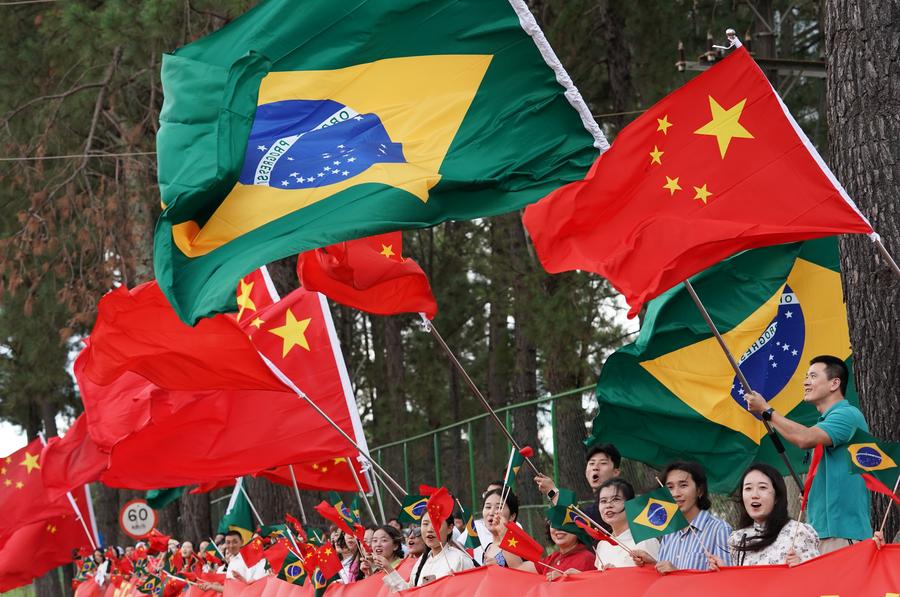
Following China’s liberation as a Communist state in 1949, many Brazilian intellectuals became interested in China, specifically interested in learning how China so quickly transformed itself into one of the most powerful nations in the world. Until the 1990s, this “China-as-Model” Theory strongly influenced the Brazilian elite classes to think of paths for the country’s development. Even on the micro level, Chinese immigrants to Brazil in the late 20th century helped to establish transnational commercial links and became a crucial player in Sino-Brazilian trade and economic relations. Since China’s reform and opening period in the 1980s and 1990s, the Chinese community in Brazil acted as bridge builders, facilitating trade, investment, and business. Additionally, Brazil was the first country in Latin America to achieve a “Comprehensive Strategy Partnership” with China. Today, Brazil has around 250,000 Chinese people — mostly in São Paulo — up from around 80,000 nearly forty years ago in 1986, and that number will only continue growing in the near future.
All in all, the Chinese community of Brazil historically struggled to amass significant numbers, but their influence reached far and wide. Brazil had to undergo debate and discussion around the ideas of slave or slave-like institutions and challenge its own perceptions of whiteness and race. Eventually, the failure to attract Chinese migrant laborers paved the way for another community to become influential in Brazilian history: the Japanese. Yet, throughout this entire story of Chinese migrant workers, the common theme that was behind all the inner workings of the colonial, imperial period was the role that intra-empire and inter-empire networks played. Brazil was allowed to pursue — but ultimately fail and try again — these initiatives that allowed it to exploit and grow. The story of the Chinese coolie shall forever be etched into Brazilian history, and the interplaying forces of opposition and advocation shall serve as a reminder that history is continuously made through opposing forces of the status quo.
Jerry Feng is an undergraduate student at Yale College studying History and Global Affairs. Jerry can be reached at jerry.feng@yale.edu.
BIBLIOGRAPHY
Bueno, André. 2023. “Traces of Chinese Culture in the Roots of Brazil.” In How China Is Transforming Brazil, edited by Mariana Hase Ueta, Mathias Alencastro, and Rosana Pinheiro-Machado, 27–40. Singapore: Springer Nature Singapore. https://doi.org/10.1007/978-981-99-3102-6_2.
Chang-Rodríguez, Eugenio. “Chinese Labor Migration into Latin America in the Nineteenth Century.” Revista de Historia de América, no. 46 (1958): 375–97. http://www.jstor.org/stable/20137297.
“China, Brazil Elevate Ties to Forge Shared Future.” People’s Republic of China State Council, November 22, 2024. https://english.www.gov.cn/news/202411/22/content_WS673fed51c6d0868f4e8ed50e.html.
Conrad, Robert. “The Planter Class and the Debate over Chinese Immigration to Brazil, 1850—1893.” The International Migration Review 9, no. 1 (1975): 41–55. https://doi.org/10.2307/3002529.
Fausto, Boris, and Sergio Fausto. A Concise History of Brazil. New York City: Cambridge University Press, 2015.
Shu, Chang-Sheng. Chinese Migration to Brazil: History, Mobility and Identities. Newcastle upon Tyne, UK: Cambridge Scholars Publishing, 2023.
Stenberg, Josh. “The Chinese of São Paulo: A Case Study.” Journal of Chinese Overseas 8, no. 1 (January 1, 2012): 105–22. https://doi.org/10.1163/179325412×634328.
Toledo Piza, Douglas de. 2023. “Chinese Migration and Changes in Brazilian Society.” In How China Is Transforming Brazil, edited by Mariana Hase Ueta, Mathias Alencastro, and
Rosana Pinheiro-Machado, 41–58. Singapore: Springer Nature Singapore. https://doi.org/10.1007/978-981-99-3102-6_3.
Viotti da Costa, Emilia. The Brazilian Empire: Myths and Histories. Chapel Hill, NC: University of North Carolina Press, 2000.