
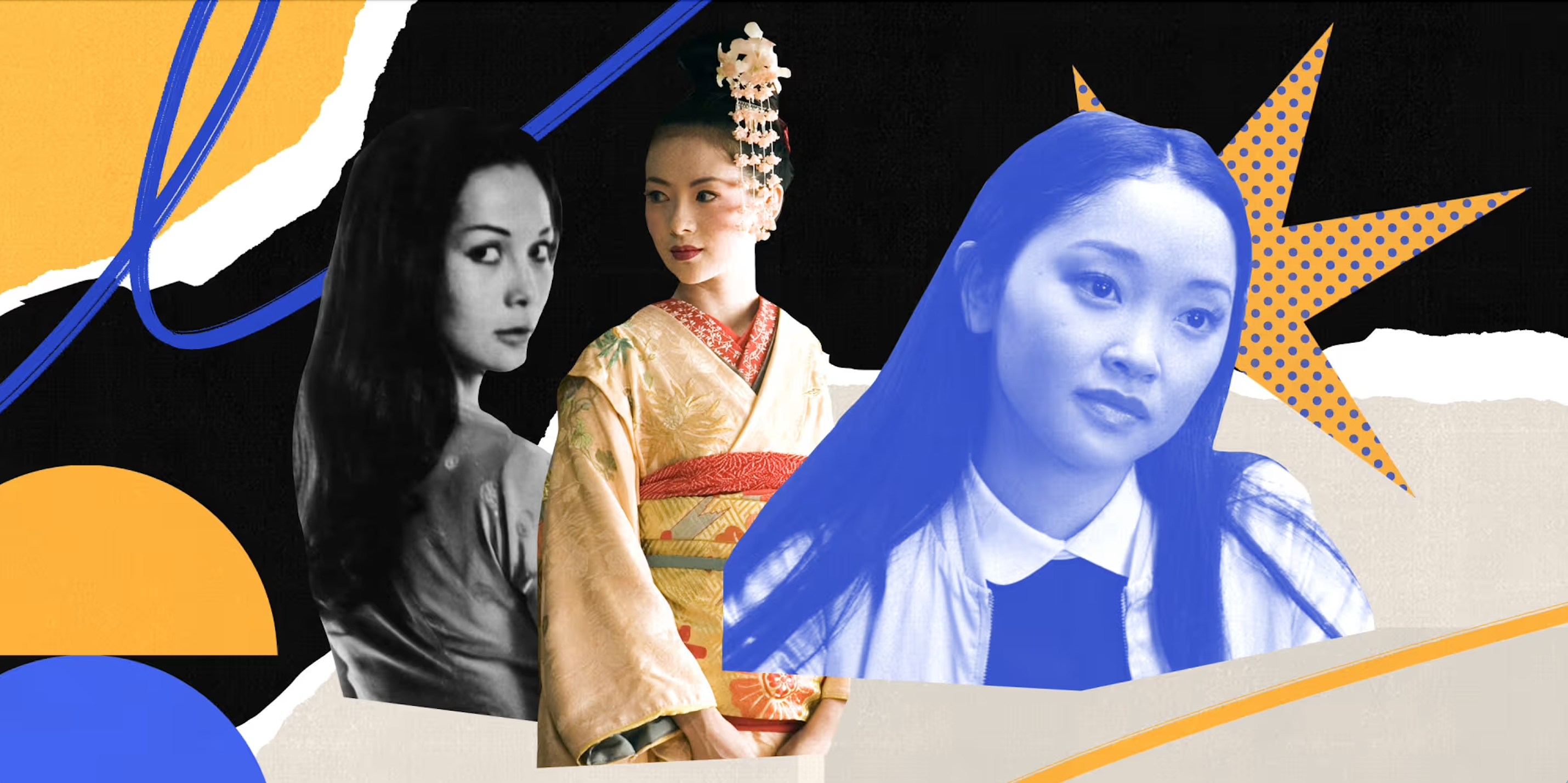
VICTORIA TANG writes about how from the Silk Road to Hollywood, East Asian women have been cast through the distorting lens of Orientalism—exoticized, commodified, and stripped of individuality. Her essay traces the historical origins of these stereotypes and reveals how hypersexualization is a colonialist construct rooted in white imperialism, sustained through modern media, and weaponized in real life as discrimination and violence.
For centuries, East Asian women have faced a dilemma when it comes to desirability: they are either labeled as undesirable according to Eurocentric beauty standards or gaslit into believing that fetishization is flattery. But like racial violence and discrimination, the hypersexualization of Asian women can lead to dangerous—even deadly—consequences. This essay argues that the fetishization of East Asian women perpetuates racism, colonialism, and white supremacy. It is deeply rooted in the history of white imperialism and colonial foundations of Oriental thinking, and it is continued in the modern day through pop culture and media representation, which commodifies East Asian women and portrays them in dehumanizing stereotypes. This results in discriminatory policies, anti-Asian attitudes, and even violence that continue to place Asian women in a dehumanizing and threatening position in real life.
The fetishization of East Asian women today is inherently colonialist, and the stereotypes about them are rooted in a history that stems from the concepts of Orientalism and white imperialism. Although Asia and the West have been connected ever since the formation of the Silk Road, the imperialist expansion efforts of the West in the early 1800s would spark a greater European interest in learning about and understanding the cultures of the East. One of the ideologies that emerged from this was Orientalism, the representation of Asia in a stereotyped way that embodies a colonialist attitude. As Edward Said, a renowned scholar on Orientalism, has argued that such “Orientalist” views of the East as seen from the West are deeply rooted in the colonial foundations of Western thinking. The dehumanization of Asian women dates back centuries to the formation of the Silk Road, along which Europe and Asia established lasting networks of cultural and material exchange that have lasted for millennia. As trade routes developed and cultures interacted across Eurasia, many cultural exports from foreign lands gained a wide appeal in Europe due to their association with luxury. This initial economic connection would be the first step in forging the semblance of exoticism and luxury that permeates Orientalism. Said observed that “the West has come to view the East as a place that is effectively trapped in time, lacking any form of development and progress.” From then on, the perception that East Asia is inferior was solidified—specifically, the belief that East Asia exists for Western pleasure. This idea of the “exotic” is further translated into sexualization. Even with a seemingly objective premise, the fascination has less to do with cultural understanding than the fetishized domination of the East. For instance, the Venetian traveler Marco Polo, in his thirteenth-century diary Travels, notes the beauty of Asian women on several occasions, writing of the women of the Kashmir province of India that “the women, although dark, are very comely.” Polo here channels the two completing colonial tropes of Asian women as standing in opposition to Western beauty standards, and yet also being beautiful. Edward Said captures the mindset succinctly, saying that “The Orient was a place where one could look for sexual experience unobtainable in Europe.” Thus, from the very beginning, the European attitude towards East Asia has been one of exoticism and fetishization, and those became common images Orientalists used to invoke a sense of fascination. That not only reduced the rich complexity of Asia to a mere fantastical concept but also assumed white domination.
Later on, during Europe’s colonization of Asia, the understanding of Asia as servile and submissive was concretized. After the Opium Wars, Western colonialists engaged in Orientalism (particularly in China and Japan) and further mythologized the East—like the land, East Asian women were also idealized as an experience to “enter and exit without consequences.” The Europeans’ first encounters with Japanese women were “with those trapped by military sex work…their understanding of Asia and East Asian women was of sex and service.” This docile archetype hypersexualizes the diverse community, and those colonial fantasies of diminutive Asian women were brought back to Europe through literature, art, and public accounts. As a way of ensuring the certainty of Western dominance over the East, these images continued circulating. The decades after World War II saw the gradual decolonization of Central and East Asia by the major powers of Europe, and millions of people from the Asian continent have migrated to the United States, comprising just over a quarter of the total US foreign-born population. Yet, the dehumanizing and commodifying portrayals of East Asia women still endure and continue to be prevalent in Western media.
Even in a modern world that has become separated from the Orientalist movement, these tropes are still promoted and carried on by Hollywood and popular media. From the age of early Hollywood cinema, white members of the film industry have viewed Asians as “mysterious and unconquered… becoming racialised fantasies and commodifiable objects for the gratification of white men.” This colonialist sexual stereotype of Asian women’s submissiveness serves as a foundation of the portrayal of East Asian women in popular culture, which is to be “less a woman than a display of… verbally inexpressive femininity.” These tropes endure in many popular films such as “Madame Butterfly,” “Austin Powers in Goldmember,” and “Kill Bill,” all of which characterize Chinese women as “slave girls, prostitutes, temptresses, and doomed lovers.” These repeated images of subordination continue to shape Western images of East Asian women as inherently dependent and innately servile, while also hypersexualized as exotic creatures who exist solely for the sexual pleasure of white men. Anna May Wong, a pioneering East Asian actress, stated, “After my death, my tombstone should engrave the words ‘she died a thousand deaths.’” Her life on screen is one of many examples of the representation of the stereotypical Asian woman who is repeatedly killed off due to failed interracial romances. Sandra Liu explains in her book Countervisions: Asian American Film Criticism that these characters “conveniently elect suicide to avoid challenging the happiness and success of their White lovers.” Through this popularization of the tragic lover, Western media portrays that the role of Asian women is to fulfill the White men’s desires and disappear when their lovers leave. Even while they are alive, Asian women are depicted as having no power in their lives and relationships, as is exemplified in the Hollywood film The World of Suzie Wong. Suzie contentedly agrees to stay with her White lover “for as long as he wants her around,” and her role is to exist and serve as long as he desires for her to exist. In essence, Asians on screen “prioritize the lives of White characters and disappear when they are unneeded.” This is also part of a broader trend. A survey of 329 Asian Americans in the entertainment industry revealed that over 93 percent agree that Asian American and Pacific Islander (AAPI) representation on screen is inadequate, and only 4.5 percent of main cast members were AAPI. Thus, these dehumanizing and unrepresentative stereotypes that are popularized by entertainment and media continue to reinforce the imagination of colonial dominance over the subordinate East Asia.
These sexual stereotypes manifest in ways that can impact women in real life, and often violently. It is easy for Asian women to be gaslighted into believing that hypersexualization is appreciation and that being “beautiful and exotic” is flattery. But as Nancy Wang, sociologist specializing in race and ethnicity in films, says, “The idea that Asian women are desirable and exotic and passive isn’t just an innocent stereotype or a desirable trait to envy…The shadowed side of that is they then become targets of hate, sexual violence and physical violence when they aren’t perceived as fully human and deserving of rights to be safe.” The Atlanta spa shootings from 2021 show how far fetishization can go. Robert Aaron Long, a white man, stated that he had a “sex addiction” as his excuse for killing eight people, and told authorities that he saw the spas as “a temptation … that he wanted to eliminate.” He used this justification because he sees Asian women as the same objects portrayed in mass media—women, dehumanized, exist only to serve men’s sexual desires, and thus it seems legitimate for him to fulfill his own desires by committing acts of violence against them. The hypersexualisation of East Asian women in media distorts the ways women are treated in real life and reinforces a Eurocentric, racist, and white supremacist cultural dynamic in the West.
Another consequence of the flattening and dehumanizing stereotypes is the fetishization of East Asian women in romantic relationships. Karina Chan, an Asian American woman who was in a romantic relationship with a white male, expressed: “I had never felt so much like I was just a body before, a literal bag of water and cellular matter…he just wanted to have sex with an exotic woman that would make sexy noises he didn’t understand.” The image of Asian women as foreign and exotic sexual objects that Chan described here is a consequence of the portrayal in the media, as well as the concept of Orientalism from history. It has been so deeply ingrained in society that not only are Asian women subject to microaggressions and fetishization, but they are also not perceived as fully human and cannot earn proper respect in relationships and life.
One of the first direct and large-scale consequences of the stereotypes of Asian Women was the Page Act. During the 1870s, a term known as “Yellow Peril” emerged in the West. This term was used to describe the racist fear of Asian dominance over American culture. As a result, the Page Act of 1875 was passed, which prohibited the immigration of “Oriental laborers” into the United States. The underlying reason for this was that the Asian (particularly Chinese) women were characterized as prostitutes, thus believed to be coming for “lewd and immoral purposes” and were a dangerous temptation for white men. Driven by media representations of sexual temptations without individuality, this stereotype of East Asian women as exotic and evil prostitutes created extreme xenophobia against Asia.
To conclude, the stereotypes of East Asian women being submissive and hypersexualized hold roots in white imperialism and orientalism. This dehumanizing and static portrayal is perpetuated by modern-day media and thus shapes the way East Asian women are perceived and treated today. It is imperative to present a more authentic and nuanced portrayal of East Asian women, and to showcase them as individuals who prioritize their own agency instead of existing for the pleasures of others.
Victoria Tang is a junior at Choate Rosemary Hall in Wallingford, Connecticut. She has a deep personal investment in the intersection and bridging of China and the US. She is especially interested in East Asian Studies, history, sociology, and has conducted field research in rural China. Her work has been recognized by The Concord Review and the Scholastic Writing Contest. She can be reached at victoriatang0518@vip.163.com.
BIBLIOGRAPHY
Barrero, Ilona. “The Harms of the Hypersexualization of East Asian Women in Western Culture.” igg-geo.org. Accessed February 22, 2024. https://igg-geo.org/?p=13281&lang=en.
Cartaya, Maria, and Et. Al. “Atlanta-area spa shooter pleads guilty to four killings and gets life in prison, but still could face death penalty.” cnn.com. Last modified July 27, 2021. Accessed February 25, 2024. https://www.cnn.com/2021/07/27/us/atlanta-spa-shooting-plea/index.html.
Cheng, Julia. “Stop fetishizing East and Southeast Asians.” breezejmu.org. Last modified April 22, 2021. Accessed February 22, 2024. https://www.breezejmu.org/opinion/opinion-stop-fetishizing-east-and-southeast-asians/article_23caffd6-a2c4-11eb-8966-f3003ece85fc.html.
Dodgson, Lindsay. “People of color explain the difference between cultural appropriation and appreciation.” businessinsider.com. Last modified September 5, 2020. Accessed February 22, 2024. https://www.businessinsider.com/difference-between-cultural-appropriation-and-appreciation-2020-9.
Lee, Joey. “East Asian ‘China Doll’ or ‘Dragon Lady’?” scholars.wlu.ca. Last modified 2018. Accessed February 22, 2024. https://scholars.wlu.ca/cgi/viewcontent.cgi?article=1026&context=bridges_contemporary_connections.
Li, Sam. “Asian Fetishization in Western Society: A Brief History.” medium.com. Last modified August 14, 2023. Accessed February 22, 2024. https://medium.com/counterarts/asian-fetishization-in-western-society-a-brief-history-41c65cacf388.
Mcdonough, Samantha. “The Fetishization of Asian Cultures in the West.” chs.globe.com. Last modified January 8, 2021. Accessed February 22, 2024. https://www.chsglobe.com/42206/features/the-fetshization-of-asian-cultures-in-the-west/.
Pham, Elyse. “Here’s how pop culture has perpetuated harmful stereotypes of Asian women.” today.com. Accessed February 26, 2024. https://www.today.com/popculture/here-s-how-pop-culture-has-perpetuated-harmful-stereotypes-asian-t213676
“The Representation of East Asian Women in Western Media.” visualculture.blog.torrontomu.ca. Accessed February 22, 2024. https://visualculture.blog.torontomu.ca/the-representation-of-east-asian-women-in-western-media/.
“The Rise of Fetishization of East Asian Women in North America.” w4w.ca. Accessed February 22, 2024. https://w4w.ca/the-rise-of-the-fetishization-of-east-asian-women-in-north-america/.
Ryu, Jenna. “The dangers of dating as an Asian American woman: ‘Fetishization isn’t appreciation.’” usatoday.com. Last modified May 10, 2022. Accessed 2024. https://www.usatoday.com/story/life/health-wellness/2022/05/10/asian-fetishization-isnt-flattery-how-weve-dehumanized-asian-women/7450959001/.
Venkatraman, Sakshi. “Almost half of all Asian roles serve as a punchline, study finds.” nbcnews.com. Last modified August 5, 2021. Accessed February 26, 2024. https://www.nbcnews.com/news/asian-america/almost-half-all-asian-roles-serve-punchline-study-finds-n1276103.
Wright, Thomas. “The Travels of Marco Polo, the Venetian.” publiclibrary.uk. Accessed February 25, 2024. http://public-library.uk/ebooks/60/81.pdf.