
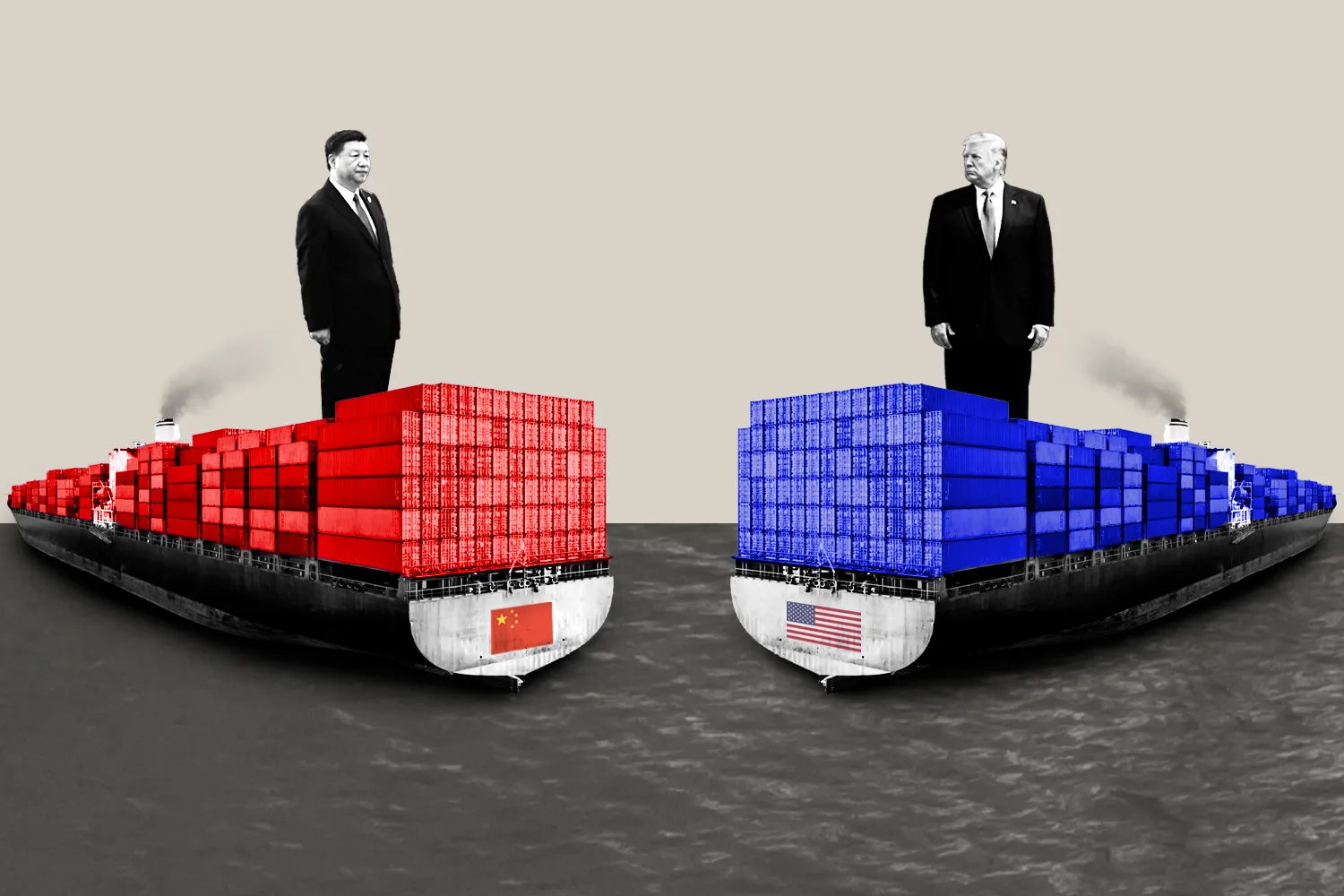
SABRINA GUO writes about the destabilizing consequences of U.S.-China economic decoupling, arguing that full separation would disrupt supply chains, raise costs for both countries, and weaken global economic stability. She contrasts broad decoupling with targeted derisking, especially in sectors like semiconductors, as a more realistic way to manage strategic competition.
Economic decoupling between the U.S. and China would be costly for both countries. In 2024, the U.S. exported $143.5 billion in goods to China, while the U.S. imported about $462 billion from China — highlighting the depth of their economic interdependence. Decoupling, abandoning bilateral trade and ending economic interdependence, would destabilize both economies as well as global markets. Advocates of decoupling, however, do raise significant strategic concerns. They argue that deep economic dependence on China exposes the U.S. to supply chain disruption and economic coercion particularly in sectors such as semiconductors, critical minerals, telecommunications, and artificial intelligence. From this perspective, reducing reliance on China is not simply a protectionist impulse, but a response to key vulnerabilities in the structure of global interdependence and an effort to limit the channels through which China might compromise U.S. national security. Yet these concerns do not necessarily support full economic separation. Rather, they suggest the need to distinguish between broad interdependence, which can generate mutual economic benefits, and concentrated dependencies in critical sectors, which may create strategic risk.
Addressing concentrated dependencies through decoupling would impose broad economic costs on the U.S, particularly by disrupting supply chains and raising production costs. This is especially true for technology firms. For instance, Apple depends on Foxconn — a manufacturer employing at least 1.4 million workers in China alone. In other words, the U.S. relies on Chinese labor and infrastructure. Reshoring production would be costly in the short term, especially if it begins suddenly and haphazardly. It would also increase prices for consumers who are already under great financial strain. According to Bank of America internal data, about 30% of American households already live paycheck-to-paycheck. China is also America’s third-largest trading partner and a major buyer of U.S. goods (e.g., soybeans, semiconductors, aerospace equipment etc.). Losing market access would be devastating. Indeed, the U.S. economy has relied heavily on China for imports and benefits a little from foreign direct investment (FDI). For American firms exporting to China, decoupling risks over $700 billion in sales and $50 billion in profits. Worse yet, this would hurt small, family-owned businesses operating on thin profit margins; many depend on Chinese suppliers to keep costs low and stay competitive with bigger businesses.
Decoupling would also harm China because it still benefits from access to U.S. technology as well as its foreign investment. The U.S. remains the world’s largest economy and a leader in advanced technology. China’s continued reliance on IP theft signals that it has not yet closed the gap. Specifically, concerns about forced technology transfer, cyber-enabled theft, and other contested practices have reinforced U.S. perceptions that China remains dependent on foreign technology in certain advanced sectors, even as China has made substantial investments in domestic innovation and industrial upgrading. In addition, decoupling amid China’s uneven post-pandemic recovery would be especially destabilizing. Also, despite state-driven initiatives like Made in China 2025, China’s tech sector still depends on U.S. chip design and semiconductor manufacturing equipment. U.S. export controls have already crippled Huawei’s smartphone business and blocked Semiconductor Manufacturing International Corporation (SMIC) from accessing key technologies like high-bandwidth memory needed for advanced chipmaking. Moreover, China is unable to produce advanced technologies like Advanced Semiconductor Materials Lithography’s (ASML) lithography machines, which help make the most advanced chips embedded in AI, smartphones, and military systems. According to the Information Technology and Innovation Foundation, China is not close to achieving self-sufficiency even in the semiconductor sector — likely reaching only 30% by the end of 2025. Also, FDI in China fell to a 30-year low in 2023 and has continued to decline since then. Attracted to lower labor costs and fewer regulatory burdens, corporations like Intel and Samsung are shifting operations to Vietnam and India. With China’s increasing standard of living and the presence of lower-cost, business-friendly developing nations — investors have strong incentives to move elsewhere.
The effects of decoupling would extend far beyond the U.S. and China. Even at the height of the Cold War, the U.S. and Soviet Union still traded with each other. Moreover, at a time when economic interconnection is greater than ever, decoupling becomes even more extreme and unrealistic. Decoupling would devastate the global economy. There’s a reason why U.S. allies as well as China’s partners largely oppose economic decoupling and favor targeted de-risking instead which would reduce strategic dependencies without severing economic ties. As Germany’s Chancellor Scholz put it, “We do not want to decouple from China, but we must reduce risks.”
As U.S.-China relations grow increasingly adversarial, supply chain vulnerability remains a significant concern. Relocating supply chains would be costly and logistically difficult for both countries. Decoupling threatens efficiencies, expertise, and long-standing relationships. Shifting parts of the supply chain to other countries means making major investments in new suppliers, infrastructure, and labor training — costs that would largely be passed onto consumers who cannot afford price hikes amid inflation and rising living expenses. The IMF warns that decoupling could cut global GDP by 7% — a $7.4 trillion loss, equivalent to the economies of France and Germany combined. That is why a targeted approach that incentivizes domestic production of semiconductors and other materials vital to national security (i.e., derisking) would be more prudent.
Derisking differs from decoupling not simply because it is less aggressive, but because it targets specific vulnerabilities rather than attempting broad economic separation. Decoupling seeks to unwind interdependence across entire sectors or economies, while derisking asks which dependencies create genuine national security or supply chain risks and addresses those narrowly. Mechanically, this would entail investing in domestic semiconductor production, diversifying suppliers for critical minerals and medical goods, maintaining export controls on the most sensitive technologies, or building backup supply chains with allies. At the same time, derisking would preserve ordinary trade in consumer goods, agriculture, services, and other sectors where interdependence is economically beneficial and less directly tied to security risks. This distinction is imperative because derisking accepts that U.S.-China economic ties cannot be fully severed without major global disruption; instead, it tries to make those ties more resilient and less vulnerable to coercion. On the other hand, decoupling perilously invites economic retaliation and undermines U.S. economic growth.
The recent escalation of the U.S.-China trade war also offers a preview of decoupling’s costs. Even short of full decoupling, U.S. tariffs on Chinese goods and China’s retaliatory tariffs on American exports have raised costs for businesses, disrupted trade flows, and forced firms to adjust supply chains under conditions of uncertainty. Small businesses that rely on Chinese inputs face higher import costs, while American exporters — including farmers selling soybeans and other agricultural goods to China — risk losing access to one of their most important markets. These effects highlight how quickly the costs of economic separation reach producers, consumers, and workers. Producers face higher input costs when tariffs raise the price of Chinese components or when firms must pay more to find alternative suppliers. Consumers then absorb many of these costs through higher prices on electronics, household goods, clothing, and other imported products. Workers are also affected when companies delay investment, relocate production, or reduce hiring because supply chains become more expensive and uncertain. If trade-war measures have already generated such costly disruptions without comprehensively severing economic ties, full decoupling would likely magnify them through broader supply chain fragmentation, sharper price increases, reduced market access for exporters, and greater instability across global markets. Ultimately, decoupling would likely exacerbate inflation, stifle innovation, and cause a global economic crisis. Fortunately, these risks can be better managed without severing economic ties, as targeted derisking may be one method to reduce strategic vulnerabilities while preserving the broader economic relationships that remain essential to global stability.
Sabrina Guo is an undergraduate student at Yale College pursuing an Intensive Major in Political Science with a concentration in U.S.-China Economic Relations, Politics, and Grand Strategy. She can be reached at sabrina.guo@yale.edu.
BIBLIOGRAPHY
Abrams, Randy. “Examining China’s Semiconductor Self-Sufficiency.” Semiconductors, November 17, 2020. https://www.semiconductors.org/wp-content/uploads/2020/11/Credit-Suisse_Randy-Abrams_Examining-Chinas-Semi-Self-Sufficiency.pdf.
Allen, Gregory C. “Understanding the Biden Administration’s Updated Export Controls.” CSIS, December 11, 2024. https://www.csis.org/analysis/understanding-biden-administrations-updated-export-controls.
Cameron, Hugh. “Number of Americans Living Paycheck to Paycheck Soars.” Newsweek, October 6, 2025. https://www.newsweek.com/americans-living-paycheck-to-paycheck-soars-goldman-sachs-10834306.
Cerullo, Megan. “What Goods Does China Import from the U.S.?” CBS News, April 11, 2025. https://www.cbsnews.com/news/china-imports-from-the-us-oilseeds-grains-oil-gas/#:~:text=Oil%20and%20gas%20shipments%20to,Motor%20vehicle%20parts:%20$1.7%20billion.
Chafetz, Glenn. “How China’s Political System Discourages Innovation and Encourages IP Theft – The Sais Review of International Affairs.” The SAIS Review of International Affairs, November 25, 2023. https://saisreview.sais.jhu.edu/how-chinas-political-system-discourages-innovation-and-encourages-ip-theft/.
“China’s Economy: How Bad Is It?” CSIS, September 9, 2025. https://www.csis.org/analysis/chinas-economy-how-bad-it.
DiPippo, Gerard. “Focus on the New Economy, Not the Old: Why China’s Economic Slowdown Understates Gains.” RAND, February 18, 2025. https://www.rand.org/pubs/commentary/2025/02/focus-on-the-new-economy-not-the-old-why-chinas-economic.html.
“Direct Investment by Country and Industry, 2024.” U.S. Bureau of Economic Analysis (BEA), July 22, 2025. https://www.bea.gov/news/2025/direct-investment-country-and-industry-2024#:~:text=Foreign%20direct%20investment%20in%20the%20United%20States,($732.9%20billion)%2C%20and%20the%20Netherlands%20($726.4%20billion).
Duggal, Hanna. “Trump Tariffs: What Products Do China and the US Buy from Each Other?” Al Jazeera, April 18, 2025. https://www.aljazeera.com/economy/2025/4/18/trump-tariffs-what-products-do-china-and-the-us-buy-from-each-other#:~:text=What%20does%20the%20US%20sell,for%2018.7%20percent%20of%20imports.
“Dying for an iPhone: The Hidden Struggle of China’s Workers.” University of Oxford Podcasts. Accessed October 21, 2025. https://podcasts.ox.ac.uk/dying-iphone-hidden-struggle-chinas-workers.
“Economy & Trade.” United States Trade Representative. Accessed October 21, 2025. https://ustr.gov/issue-areas/economy-trade.
“Everything You Need to Know about the U.S. Semiconductor Restrictions on China.” Microchip USA, December 17, 2024. https://www.microchipusa.com/industry-news/everything-you-need-to-know-about-the-u-s-semiconductor-restrictions-on-china?srsltid=AfmBOopftPwPV68hbqnMozuN60SoA_yt1ubT2CtWOdPSSZmmZs42CTpx.
Feingold, Spencer, and Lea Weibel. “Economic Decoupling? 3 Experts Caution What That Means for the Global Economy.” World Economic Forum, June 27, 2023. https://www.weforum.org/stories/2023/06/global-economic-decoupling-derisking-experts-explain/.
Freyer, Janis Mackey, and Mithil Aggarwal. “China’s Economic Woes Give Its Markets a Week to Forget, and Its Public Little Cause for Optimism.” NBC News, October 12, 2024. https://www.nbcnews.com/news/world/chinas-economic-woes-give-markets-week-forget-public-little-cause-opti-rcna174466.
Hwang, Tim, and Emily S. Weinstein. Decoupling in Strategic Technologies: From Satellites to Artificial Intelligence. Washington, DC: Center for Security and Emerging Technology, July 2022. https://cset.georgetown.edu/wp-content/uploads/CSET-Decoupling-in-
Strategic-Technologies-3.pdf
“The High Cost of Global Economic Fragmentation.” IMF, August 28, 2023. https://www.imf.org/en/Blogs/Articles/2023/08/28/the-high-cost-of-global-economic-fragmentation.
Kharpal, Arjun. “From No. 1 to No. 6, Huawei Smartphone Shipments Plunge 41% as U.S. Sanctions Bite.” CNBC, January 28, 2021. https://www.cnbc.com/2021/01/28/huawei-q4-smartphone-shipments-plunge-41percent-as-us-sanctions-bite.html.
Kronenberg, Alan, and Jaclyn Jeffrey-Wilensky. “Which Countries Are the Biggest U.S. Trade Partners?” U.S. News & World Report, December 3, 2024. https://www.usnews.com/news/best-countries/articles/which-countries-are-the-biggest-u-s-trade-partners.
Li, Xiangyuan, and Haizheng Li. “The COVID-19 Pandemic’s Impact on the Chinese Economy.” China Research Center, February 27, 2025. https://www.chinacenter.net/2023/china-currents/22-1/the-covid-19-pandemics-impact-on-the-chinese-economy/.
Liu, John. “China’s Foreign Investment Sank in January. Can Beijing Turn Things around?” CNN, February 20, 2025. https://edition.cnn.com/2025/02/20/economy/china-fdi-jan-decline-intl-hnk.
Liu, John. “How US Exerts Controls over Foreign Chipmakers in China | CNN Business.” CNN, September 5, 2025. https://www.cnn.com/2025/09/05/business/us-chip-control-china-intl-hnk.
McKenna, Greg. “The U.S.-China Trade War Is about to Pummel America’s Small Businesses, Apollo Economist Says.” Fortune, April 28, 2025. https://fortune.com/article/china-trade-war-small-businesses-apollo-economist/.
McNair, Kamaron. “Nearly Half of Americans Say They Live Paycheck to Paycheck.” CNBC, November 19, 2024. https://www.cnbc.com/2024/11/19/bank-of-america-nearly-half-of-americans-live-paycheck-to-paycheck.html.
Miller, Chris. “What Is China’s Biggest Challenge to Achieving Chip Self-Sufficiency?” YouTube, July 22, 2025. https://www.youtube.com/watch?v=13JtkswT_bU&t=24s.
“The People’s Republic of China.” United States Trade Representative. Accessed October 21, 2025. https://ustr.gov/countries-regions/china-mongolia-taiwan/peoples-republic-china.
Perlin, Ross. “Chinese Workers Foxconned.” Dissent Magazine, April 16, 2013. https://www.dissentmagazine.org/article/chinese-workers-foxconned/.
Rosenbach, Eric, Lea Baltussen, Eleanor Crane, Ethan Kessler, Lukasz Kolodziej, Ethan Lee, Alexandre Meyer, Cynthia Tong, and Britney Tran. “Critical and Emerging Technologies Index June 2025.” Belfer Center, June 2025. https://www.belfercenter.org/sites/default/files/2025-06/Belfer_CET_2.4.pdf.
Scholz, Olaf. “We Don’t Want to Decouple from China, but Can’t Be Overreliant.” POLITICO, November 3, 2022. https://www.politico.eu/article/olaf-scholz-we-dont-want-to-decouple-from-china-but-cant-be-overreliant/
Shalal, Andrea. “Exclusive: WTO Chief Urges U.S., China to De-escalate Trade War, or Risk Long-Term Hit to Global Growth.” Reuters, October 17, 2025. https://www.reuters.com/world/china/wto-chief-urges-us-china-de-escalate-trade-war-or-risk-long-term-hit-global-2025-10-17/
Sheldon, Peter, and Seung-Ho Kwon. 2023. “Samsung in Vietnam: FDI, Business–Government Relations, Industrial Parks, and Skills Shortages.” The Economic and Labour Relations Review 34 (1): 66-85. https://doi.org/10.1017/elr.2022.3
Shivakumar, Sujai, Charles Wessner, and Thomas Howell. “Balancing the Ledger: Export Controls on U.S. Chip Technology to China.” CSIS, February 21, 2024. https://www.csis.org/analysis/balancing-ledger-export-controls-us-chip-technology-china.
U.S Relations with China, February 19, 2025. https://china.usembassy-china.org.cn/u-s-relations-with-china/.
Vertinsky, Ilan. “Counting the Cost of US-China Decoupling: Is There a Way Back?” CEIBS, June 13, 2023. https://www.ceibs.edu/new-papers-columns/23264#:~:text=Decoupling%20with%20China%20risks%20all,export%20to%20the%20Chinese%20market.
Wright, Logan. “China’s Economy Has Peaked. Can Beijing Redefine Its Goals?.” Rhodium Group, September 1, 2024. https://rhg.com/research/chinas-economy-has-peaked-can-beijing-redefine-its-goals/.
Yong, Nicholas. “Industrial Espionage: How China Sneaks out America’s Technology Secrets.” BBC News, January 16, 2023. https://www.bbc.com/news/world-asia-china-64206950.
Мartins, Ricardo. “Decoupling from China? The Consequences of a Stupid Idea.” New Eastern Outlook, October 10, 2024. https://journal-neo.su/2024/10/10/decoupling-from-china-the-consequences-of-a-stupid-idea/.