
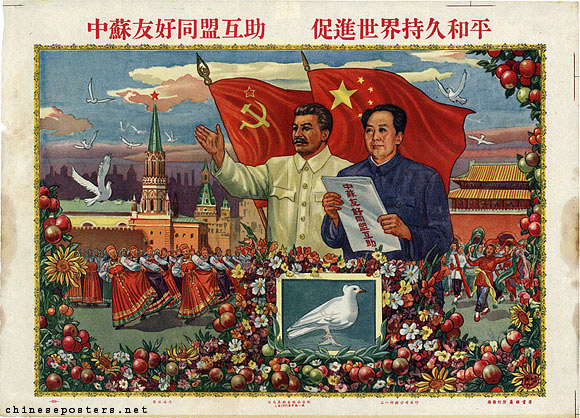
BENJAMIN NULAND examines the opening relationship between China and the Soviet Union during the CCP’s first year of control over mainland China, from the conquest of Beijing in January 1949 to the signing of the Sino–Soviet Treaty in February 1950. It analyzes Soviet support for renewing China’s foreign relations, securing its borderlands, and promoting economic development, while also highlighting limits and misalignments in the partnership that contributed to growing tensions in the decades that followed.
The Chinese Communist Party (CCP) captured Beijing on January 30, 1949, in an offensive that dealt the final blow to the Nationalist Party’s control over the mainland. Having never before governed an entire nation as the sole ruling party, the CCP sought advice from the Soviet Union on how to construct its new state. From January 1949 to the crystallization of the Sino–Soviet alliance in February 1950, Stalin communicated directly with Mao Zedong on the formation of China’s foreign relations, the management of domestic borderlands, and the development of a new economic plan supported by Soviet aid. This paper asks: How did the Soviet Union support the Chinese Communist Party in its first year in power across these three domains? To what extent was this partnership collaborative, and where did tensions and disagreements emerge? Finally, how did these early patterns of cooperation and contention shape the trajectory of the Sino–Soviet relationship in the years that followed? Because this paper examines the formulation of the Sino–Soviet relationship rather than the final decision-making stage, it does not focus on the negotiations between Mao Zedong and Joseph Stalin during Mao’s two-month visit to the Soviet Union. Instead, the paper concentrates on the preceding period, from the end of the Chinese Civil War to the beginning of those negotiations, in order to understand how the relationship was initially shaped.
For context, the CCP had several reasons to pursue a closer relationship with the Soviet Union. Ideologically, the CCP’s adoption of Marxist–Leninist doctrine framed the United States as an antagonist and an “inherently aggressive and counterrevolutionary imperialist power.”1 This perception was reinforced by the belief that the United States supported the Nationalist Party during the Chinese Civil War. Even when the effectiveness of American support appeared to decline, CCP leaders believed that the United States had switched to encouraging ‘splitism’ within the CCP-led anti-imperialist united front to create an internal opposition. On the domestic front, the CCP leaders were frustrated by the failures of earlier attempts at democratic economic reform under both the late Qing dynasty and the Nationalist government.2 As a result, they were eager to identify a successful and proven model for rapid industrialization, which made the Soviet experience particularly attractive.
The Soviet Union however remained skeptical about forming a close relationship with the CCP. Ideological differences were evident in the CCP’s interpretation of “class struggle” and “class character.” Mao’s revolutionary base consisted primarily of peasants rather than the urban proletariat traditionally emphasized in Marxist theory. Stalin also believed that Mao’s “inclination toward nationalist independence” reflected potentially bourgeois tendencies. The recent rupture between the Soviet Union and Yugoslavia further heightened Stalin’s suspicions. Fearing that the United States might attempt to encourage a form of ‘Chinese Titoism,’ Stalin worried that the CCP might ultimately resemble the Yugoslav communists in their independence from Moscow (at around the same time).3 Therefore Soviet assistance was initially offered cautiously, at a distance, and in limited forms.
The CCP was aware of these Soviet concerns, particularly during the formulation of its new coalition government in late January of 1949. Soviet advisers warned against creating too much political space for democratic parties and other “elements” within the coalition government, arguing that pro-Western actors might use such openings to infiltrate the revolution. Moreover, the Soviets encouraged the CCP to establish the coalition government sooner rather than later, warning that the Nationalists might use the intervening time to rally an alternative coalition that could challenge CCP authority.4 According to Wu Xiuquan, it was for these reasons that “the Soviet leadership was initially ‘indifferent and skeptical’ toward the CCP.”5 Awareness of these Soviet reservations pushed the CCP to pursue a more proactive relationship with the Soviet Union. Although Mao had already demonstrated his effectiveness as a military commander and leader of the communist movement in China, he still needed to prove not only his loyalty to Stalin but also his commitment to eliminating alternative sources of political influence.
Pressure to secure Soviet support pushed the Chinese Communist Party (CCP) to reshape China’s foreign relations even before the establishment of the People’s Republic. Central to this effort was the policy of “Cleaning the House Before Inviting the Guests,” which aimed to eliminate Western influence in China before the CCP formally opened diplomatic relations with foreign states. Although the Soviets offered advice, the campaign was largely driven by the CCP itself through a gradual pressure strategy directed at foreign institutions and diplomatic missions.
The campaign began with a nationalist and anti-foreign fervor. In January 1949, the CCP drafted internal plans for managing foreign institutions within their territory, as outlined in the “Guidelines of the Chinese Communist Party on the Question of Work in the Sphere of Foreign Policy,” which called for heavy surveillance and state interference in China-based western media.6 78At the same time, Zhou Enlai remarked to Anastas Mikoyan that state media fabricated accusations of Western organizations of espionage and subversive activity to justify tighter restrictions on foreign presence. Officially, CCP leaders told the Soviets that their policy was not to provoke the United States but to retaliate only if Washington openly opposed the new regime. In practice, however, the pressure campaign sought to compel foreign diplomats either to evacuate China or to establish de facto relations with Communist authorities.9
The CCP soon escalated these pressures through direct actions against foreign missions. Communist authorities stormed the U.S. consulate in Shenyang and seized former Beijing military barracks used by American diplomats. Following the recommendation of Soviet advisor Ivan Kovalev, the CCP also forced the United States to surrender radio transmitters used by its embassy, effectively cutting off communication with Washington.10 Even individuals close to the CCP were not exempt: under the personal advice of Joseph Stalin, American communist Sidney Rittenberg was arrested and placed in solitary confinement on suspicion of espionage.1112 But even as the CCP escalated pressure on Western diplomatic presence, Soviet leaders urged caution in handling American economic interests in China. Moscow recommended that the CCP avoid nationalizing American-owned property while proceeding with the nationalization of Japanese and British assets, in order to avoid provoking the United States. At the same time, the Soviet Union signaled its willingness to liquidate its own assets in China so long as new forms of bilateral economic cooperation could be established.13
Nevertheless, the CCP viewed the removal of Western influence as an opportunity to reset China’s international position. With Soviet backing, the People’s Republic quickly established relations with Eastern European communist states and a broader note, establishing a gradience in relationships to distinguish ally from foe. Within a week of the PRC’s founding on October 1, the Soviet Union, Bulgaria, Romania, Hungary, Czechoslovakia, and Poland had recognized the new government and exchanged ambassadors. Mao and Soviet representatives also discussed the possibility of establishing a Communist Party coordination bureau for Asia centered in Beijing, although Moscow preferred a more limited East Asian framework in order to retain influence over Southeast Asian revolutionary movements.14 Toward Western countries, the CCP adopted a more gradual approach, believing that formal relations should only emerge through negotiations that established a new framework based on equality and noninterference in China’s internal affairs. Nevertheless, rejecting treaties signed by the Nationalist government, such as on the Changchun Railway and Port Arthur, the CCP hoped to erase what it saw as the unequal diplomatic legacy of the Chinese Nationalist Party/Guomindang (GMD) era and renegotiate China’s international obligations on more equal terms.15

Reconstructing China’s international position, however, required not only redefining relations with external powers but also renegotiating the terms of its partnership with the Soviet Union. This was especially evident in the management of China’s borderlands, where questions of sovereignty, security, and cooperation were most acute. Manchuria thus emerged as the primary testing ground of the early Sino–Soviet relationship.
Manchuria occupied a central place in this cooperation, functioning simultaneously as China’s primary industrial base and a strategic buffer zone. Soviet actions prior to 1949, most notably the withdrawal of forces in 1946 and the transfer of Japanese military equipment, were decisive in enabling the CCP to consolidate control in the region. These contributions facilitated rapid military expansion and early dominance over Nationalist forces.16 Yet the same region that symbolized cooperation also exposed structural tensions over sovereignty and political authority.
A key source of friction emerged over the issue of “war trophies.” Soviet removal of industrial machinery from Manchuria generated widespread domestic resentment within China, particularly among workers and students who viewed the extraction as a loss of vital economic assets. While CCP leaders such as Liu Shaoqi publicly defended Soviet actions diplomatically, framing them as legitimate seizures to prevent use by “reactionary” nationalist forces, internal leadership faced the emerging dual challenge of preserving the alliance while managing domestic discontent.17 Mao’s own frustration with the protracted negotiations over the 1950 agreements, particularly Soviet privileges in Dalian and Port Arthur, further reflected concerns over unequal arrangements and delayed restoration of ‘Chinese sovereignty.’ Compounding such worries were suspicions by the CCP of excessive Soviet influence in Manchuria. The absence of clearly demarcated borders and the prominence of Soviet advisors raised concerns that Manchuria might drift toward dependence or even reintegration into the Soviet sphere, as reflected in Gao Gang’s warnings.
On the Soviet side, concerns centered less on territorial sovereignty than on the CCP’s capacity to maintain ideological and organizational control. This was evident in the case of Li Lisan, a senior figure in Manchuria with a history of “Trotskyist” errors. While Mao defended Li as an “honest communist,” Stalin’s envoy Anastas Mikoyan cautioned that he was “loquacious” and lacked practical experience.1819Mao, in turn, reassured the Soviets that any deviation would be swiftly corrected by senior leaders such as Liu Shaoqi. The exchange illustrated how Soviet involvement hoped to extend into intra-party oversight, reinforcing anti-Trotskyist discipline while simultaneously raising concerns within the CCP about external interference in internal governance.
In part to address these overlapping concerns of both CCP anxieties over sovereignty and Soviet concerns over political control, the USSR deepened its economic engagement in Manchuria. The most tangible form of support was the reconstruction of infrastructure, particularly the transportation network devastated by war. Soviet specialists played a central role in restoring approximately 10,000 kilometers of railway track, with Mao noting the speed and preparedness with which engineers were dispatched upon request.20 Beyond railways, the CCP sought at least 300 Soviet specialists to replace departing Japanese experts in key sectors such as metallurgy, aviation, military production, and power generation; by 1960, roughly 11,000 Soviet experts had been sent to China.21
Material concessions further reinforced this cooperation. Under the 1950 agreements, the USSR transferred its rights to the Chinese Changchun Railway (CCR) to China without payment, despite having borne much of the operational cost under earlier arrangements with the Nationalists.22 This transfer included not only legal ownership but also rolling stock, land, real estate, and associated industrial facilities. Additionally, the Soviets developed border hubs such as Manzhouli and Otpor into major international transshipment centers, with cargo throughput increasing dramatically from 715,000 tons in 1951 to nearly 4.4 million tons by 1955. These measures addressed immediate logistical challenges and strengthened Manchuria’s integration into both the Chinese national economy and the broader socialist bloc.23
Soviet involvement also extended into mediation and policy guidance. In 1950, the CCP requested Soviet assistance in securing electricity supplies, asking Moscow to mediate with North Korea to guarantee Manchuria 50 percent of output from Yalu River hydroelectric stations. The CCP also sought help in stabilizing currency across Manchuria and the Port Arthur–Dalian region to prevent unemployment and worker unrest.24 At the policy level, Stalin advised Chen Yun not to alienate the national bourgeoisie, encouraging their participation in trade to support economic recovery.

Yet cooperation did not eliminate underlying contradictions. Generous Soviet technical and economic support in Manchuria was seen as a developmental success for China but also leverage for Soviet influence. The issue of Port Arthur revealed a fundamental paradox: while the CCP criticized Soviet privileges as infringements on sovereignty, it simultaneously depended on Soviet presence for security. In February 1949, Mikoyan proposed canceling the 1945 treaty and withdrawing Soviet forces, labeling the arrangement “unequal.” Rather than welcoming this as a restoration of sovereignty, Mao and the CCP Politburo reacted with surprise and opposition, arguing that withdrawal would expose China to U.S. and Japanese influence especially in the context of rising tensions on the Korean Peninsula.25 By July 1949, Chinese officials went further, suggesting that Soviet forces remain not for 30 years, as stipulated, but potentially for 60.26 China’s lack of naval capacity and the perceived deterrent value of a Soviet military presence meant that Mao was willing to manage the domestic contradiction by framing the arrangement as a temporary and “patriotic” necessity, distinguishing it from imperialist bases and emphasizing that Soviet withdrawal would occur once China achieved sufficient strength.27
Manchuria therefore encapsulates the broader dynamics of early Sino–Soviet relations. Soviet support was foundational to CCP consolidation, providing critical military, industrial, and administrative capacity. At the same time, persistent tensions over sovereignty and political control required constant negotiation. The CCP’s approach to leveraging Soviet assistance while seeking to contain its political implications established a pattern of cooperation marked by underlying suspicion, a dynamic that would ultimately contribute to the breakdown of the alliance in the 1960s.
Manchuria revealed tensions over influence within a shared strategic space, but Mongolia more directly exposed the limits of Sino–Soviet alignment where questions of sovereignty and territorial integrity were non-negotiable. From the outset, Soviet policy toward Mongolia was shaped by a clear concern of preventing any resurgence of Chinese “great power chauvinistic” ambitions in the region. Anastas Mikoyan explicitly cautioned Mao Zedong that the USSR would not support any initiative that might “cut away” territories or undermine the independence of the Mongolian People’s Republic (MPR). Preserving Mongolia as a Soviet-aligned buffer state was a strategic priority that framed all subsequent cooperation.28
Within these constraints, however, the Soviets actively guided CCP policy in Inner Mongolia. Soviet criticism of earlier CCP practices in the region but open to accepting autonomy rather than independence of Inner Mongolians from China, Mao in turn acknowledged that the Party was drawing from Bolshevik approaches to the “national question,” particularly the principle of granting autonomy rather than independence to minority regions. Zhou Enlai admitted that the Party had committed “leftist” errors, including the harsh treatment of Mongolian princes and lamas and the confiscation of elite landholdings.29 With Soviet encouragement and pressure, the CCP shifted toward a more integrationist and pragmatic approach. Gao Gang was tasked with conducting “explanatory work,” and revised policies allowed “young royalty” and traditional elites to participate in local governance, with some even joining the CCP. This recalibration aimed to stabilize Inner Mongolia by accommodating “national specifics” without compromising territorial control.
Beyond political guidance, cooperation extended into infrastructure and border management. Ren Bishi’s proposal to construct a railway linking Ulaanbaatar with Kalgan reflected a shared interest in deepening economic and strategic connectivity across the frontier, an idea Mikoyan acknowledged as worthy of further consideration.30 Practical collaboration also emerged in border governance: joint efforts included agreements on forest and steppe fire prevention, bilateral scientific research on boundary rivers, and even coordinated disaster response. A notable example occurred when Soviet aircraft assisted in bombing ice blockages on the Argun River to prevent flooding in Chinese border communities.31 These forms of cooperation suggest that, at the operational level, Sino–Soviet coordination in Mongolia could be both functional and mutually beneficial.
Yet this managed cooperation did not resolve the core strategic divergence. Mao’s proposal to unify Outer and Inner Mongolia within the Chinese state brought underlying tensions to the surface. He suggested that Outer Mongolia might eventually “accede” to China following the CCP’s consolidation of power. For the Soviet leadership, this was unacceptable. Mikoyan rejected the idea outright, arguing that Outer Mongolia had long experienced independence and would not voluntarily relinquish it. Mao ultimately withdrew the proposal, but the episode revealed the sharp boundary of Soviet tolerance.32 While this boundary was institutionalized in the 1950 Treaty of Friendship, Alliance, and Mutual Assistance where Stalin made Chinese recognition of the MPR’s sovereignty a non-negotiable condition, for the CCP this concession carried significant symbolic weight, requiring the abandonment of longstanding territorial claims and reinforcing perceptions of unresolved “national humiliation.”33
In contrast to Manchuria, where tensions centered on degrees of Soviet influence, Mongolia represented a case where Soviet strategic priorities definitively constrained Chinese ambitions. The CCP’s willingness to adopt Soviet models in managing Inner Mongolia coexisted uneasily with its inability to alter the status of Outer Mongolia. Soviet support was instrumental but conditional, enabling governance and stability while simultaneously delimiting the outer bounds of Chinese sovereignty.
Xinjiang represented an even more sensitive frontier, one where Soviet influence and economic interests intersected most directly. CCP anxieties over Soviet involvement in the region predated the establishment of the People’s Republic and the Chinese Civil War. Moscow’s prior incorporation of Central Asia, along with its close relationship with the warlord Sheng Shicai, had already created entrenched channels of influence in Xinjiang. By 1949, the CCP viewed the region not only as strategically vital but also as vulnerable to external manipulation. These suspicions surfaced most clearly how the CCP observed the Yili insurgency. During the February 1949 meetings in Xibaipo, Mao directly confronted Anastas Mikoyan with reports that Uyghur forces had been equipped with Soviet-made artillery, tanks, and aircraft. Mikoyan issued a categorical denial, instead reframing the unrest as a “national movement against oppression” caused by the Chinese government’s failure to account for “national specifics.”34 This exchange revealed a fundamental divergence that while the CCP suspected covert Soviet backing of separatist forces, the Soviets attributed instability to Chinese “chauvinism” and governance failures.35
Despite these tensions, Soviet support proved instrumental in enabling the CCP’s rapid consolidation of Xinjiang.36 In strategic terms, Moscow sought regional stability without committing to a large-scale military presence, while still securing access to key resources such as oil and cotton. Stalin also played into the Great Game Theory of geopolitical competition in Central Asia, and urged Mao to move quickly to occupy Xinjiang in order to preempt suspected British influence from South Asia and stabilize the frontier.37 Stalin relied on military and logistical support to ensure that the CCP could secure Xinjiang by force in October 1949. The Soviet Union facilitated the airlift of a PLA division from Lanzhou to Urumqi, supplying 1,000 tons of aviation fuel and 10,000 tons of grain to sustain the move.38 Stalin also offered 40 fighter aircraft to assist in defeating the forces of the Muslim warlord Ma Bufang.39
Beyond immediate military aid, Soviet involvement extended into economic material support. Soviet technicians established radio links connecting Xinjiang with Beijing and Moscow, while specialists were dispatched to develop oil extraction and metallurgical industries.40 Stalin repeatedly emphasized the importance of Xinjiang’s cotton and petroleum resources, envisioning a model akin to Soviet Central Asia, where resource extraction could serve broader socialist development.41 Complementing this, Zhu De proposed the use of Soviet mechanized agriculture, particularly tractors, to both sustain PLA forces and demonstrate the benefits of modern production to local populations.42

More controversially, Soviet guidance extended into demographic engineering. Stalin advised Mao to increase the Han Chinese population in Xinjiang from roughly 5 percent to 30 percent in order to strengthen “border protection” and secure control over subsoil resources.43 44The political consolidation of the region was further shaped by ambiguous events, such as the August 1949 plane crash near Irkutsk that killed key leaders of the Second East Turkestan Republic en route to Beijing. While the degree of Soviet or CCP involvement remains unclear, the incident removed a potential source of organized opposition and facilitated CCP authority in the region.45
However, Soviet assistance came with significant constraints that limited Chinese autonomy to use Xinjiang in its own economic interests. The 1950 Secret Protocol prohibited nationals of third countries from residing or conducting business in Xinjiang, effectively designating the region as a Sino–Soviet security sphere. While this arrangement reduced the risk of Western penetration, it also restricted China’s ability to independently engage with external economic partners, reinforcing Soviet influence over regional development.46 A further divergence emerged over infrastructure strategy. Mao, supported by Ren Bishi, proposed constructing a railway linking Xinjiang to the Soviet Union, framing it as essential for “joint defense” and deeper integration. Mikoyan, however, dismissed the project as prohibitively expensive, reflecting Stalin’s preference to maintain Xinjiang as a loosely connected resource-rich buffer zone without the high cost of a trans-continental link and a fully integrated corridor.47
These constraints generated significant resentment within the CCP leadership. Although Mao accepted Soviet terms in exchange for military and financial support, he later characterized these arrangements as “niggling” infringements on Chinese sovereignty. More broadly, such concessions were interpreted as a continuation of the “national humiliation” imposed by other foreign powers.48 49After Stalin’s death, Mao would go further, condemning these Soviet policies as manifestations of “great power chauvinism” over Chinese sovereign territorial claims and pressing for their reversal.
In contrast to Manchuria’s negotiated interdependence and Mongolia’s clearly delimited sovereignty, Xinjiang represented a hybrid case. It was a region where Soviet military and economic support proved indispensable to CCP consolidation, yet that support was structured in ways that constrained China’s political and economic autonomy. The CCP’s experience in Xinjiang thus reinforced a recurring pattern in early Sino–Soviet relations: deep reliance enabling rapid development and stabilization, coupled with persistent suspicion of Soviet involvement in sensitive borderland regions. At the same time, Chinese leaders grew increasingly frustrated with the ways in which Soviet-imposed limitations circumscribed China’s territorial sovereignty and curtailed its ability to exercise independent control over its frontier.
Perhaps the most consequential dimension of the 1949 Sino–Soviet relationship was economic state-building. In what has often been described as one of the largest transfers of technology and expertise in modern history, the USSR dispatched a wide array of specialists across sectors.50 Ivan Kovalev operated at the highest levels of national economic planning, while Soviet advisers assisted in financial reform, banking system construction, and industrial administration.51 In Shanghai alone, 15 specialists were deployed to manage power generation, water systems, and key enterprises, reflecting Mao’s concern that the CCP lacked the technical capacity to govern a major industrial metropolis.52 Training programs further deepened this dependence: thousands of Chinese cadres studied in Soviet institutions, including a dedicated program for 1,000 students in industrial management, trade, finance, and law, alongside shorter-term technical training for senior managers.53
Industrial cooperation amplified both the scale of assistance and the underlying tensions. The 156 key projects supported by approximately 11,000 Soviet specialists between 1950 and 1960 accounted for over half of China’s capital investment during the First Five-Year Plan and established entire sectors such as aviation, petroleum refining, and manufacturing.54 55Infrastructure recovery complemented this effort, where Soviet engineers assisted in constructing major projects like the Wuhan Yangtze River bridge and provided minesweepers to reopen maritime trade routes near Shanghai.56 Trade mechanisms, including “goods-for-goods” exchanges, further integrated China into Soviet supply chains while alleviating pressure on scarce foreign currency reserves.57
Yet while Soviet involvement in the borderlands exposed tensions over sovereignty and security, economic cooperation revealed a parallel struggle over the pace and direction of socialist transformation. At issue was not simply how to rebuild China, but how socialism itself should be constructed, and how quickly.
This tension was embedded from the outset in the structure of Soviet aid. The $300 million credit, extended at a preferential 1 percent interest rate, was justified by China’s condition of “war” and “devastation.” However, it was not disbursed in cash but in machinery and industrial materials delivered in fixed annual installments of $60 million over five years.58 This structure imposed a logic of sequencing where industrial growth was tied to Soviet supply schedules and planned absorption rates, but also constraining Mao’s desire for flexibility and speed.
At the core of these frictions lay a fundamental disagreement over time horizons. Stalin consistently advanced a model of pragmatic gradualism. He urged the CCP to scale back overly ambitious targets, recommending a reduction in projected industrial growth from 20 percent to 15 percent to preserve a “margin of error.”59 He also advised maintaining the national bourgeoisie and sustaining a mixed economy for ten to fifteen years, viewing private enterprise as essential for recovery and urban stability.60 At the same time, Stalin encouraged transforming cities like Shanghai into “fortresses” of socialism, while paradoxically advocating tactical accommodation of foreign capital as a means of buying time.6162
To Mao, this approach appeared both constraining and ideologically inconsistent. Eager to cut corners, he viewed prolonged coexistence with capitalist elements as diluting revolutionary momentum and delaying socialist transformation.63 This divergence extended into the countryside, where land reform became another fault line. Stalin warned against the abrupt expropriation of rich peasants, advocating a two-stage approach that eliminated landlords while temporarily preserving wealthier rural strata to prevent a collapse in agricultural output. 6465Although the CCP initially followed this framework, Mao later distanced himself from it, portraying such moderation as externally imposed and seeking to reclaim ideological ownership over China’s revolutionary path.66
These tensions extended into institutional design of development. Chinese leaders sought to replicate Soviet planning structures, sending delegations to study the Soviet State Planning Committee (Gosplan), which informed the creation of China’s State Planning Commission in 1952. Yet Stalin resisted wholesale transplantation.67 When Mao proposed a large, centralized administrative-planning apparatus, Stalin advised simplifying and adapting it to Chinese conditions, insisting it be staffed primarily by Chinese officials, with Soviet advisers confined to consultative roles.68 A deeper divergence emerged that while the CCP viewed Soviet institutions as models to be rapidly reproduced, Soviet leaders didn’t believe China’s developmental stage was ready for soviet style transformation and as requiring flexibility rather than rigid imitation.
The result was a dual dynamic that defined early Sino–Soviet economic relations. On one level, Soviet assistance enabled a scale of industrialization and institutional formation that the CCP could not have achieved independently. On another, it generated persistent friction over authority, over who determined the path of socialist development and at what pace it should proceed. Economic cooperation, therefore, was not merely a transfer of resources, but an ongoing negotiation over developmental ownership itself. Alignment in material capacity did not produce alignment in vision, and it was this gap between Soviet gradualism and Maoist acceleration that would widen into deeper ideological and strategic fractures in the years that followed.
The first year of Sino–Soviet engagement in 1949 reveals a relationship that was neither purely hierarchical nor fully cooperative, but fundamentally negotiated across multiple domains. Soviet support proved indispensable to the Chinese Communist Party’s consolidation of power. It enabled the rapid stabilization of borderlands, the reconstruction of critical infrastructure, and the establishment of a modern industrial and administrative state. In foreign policy, Soviet backing helped the CCP reorient China toward the socialist bloc and dismantle Western influence. In regions such as Manchuria, Mongolia, and Xinjiang, Soviet assistance provided the military, economic, and technical capacity necessary for territorial consolidation. In economic planning, Soviet models and material transfers supplied the institutional and industrial foundations of the new regime.
Yet this support was never unconditional. Across each domain, cooperation was accompanied by persistent tensions over sovereignty and developmental direction. In the borderlands, Soviet involvement raised fears of political intrusion and territorial constraint; in Mongolia, it imposed clear limits on Chinese ambitions; in Xinjiang, it embedded China within a Soviet security and economic sphere. In economic state-building, the most consequential disagreements centered on time horizons and ideological ownership, as Stalin’s gradualist approach clashed with Mao’s preference for accelerated transformation. Even where Soviet assistance was most generous, it carried implicit constraints that the CCP sought to manage, reinterpret, or eventually resist.
These early patterns established a durable pathway that would define the trajectory of Sino–Soviet relations in the decade that followed. The alliance was built on asymmetrical interdependence that China relied heavily on Soviet resources and expertise, while simultaneously seeking to preserve autonomy and assert its own revolutionary path. This tension between dependence and independence did not remain latent. Rather, it hardened over time into ideological divergence and strategic mistrust, ultimately culminating in the Sino–Soviet split of the 1960s. What emerged in 1949–1950, therefore, was not simply a partnership of socialist solidarity, but the foundation of a relationship marked by deep cooperation constrained by equally deep suspicion and an uneasy alignment in which shared interests masked fundamentally different visions of power, sovereignty, and socialist development.
Benjamin M. Nuland (Yale ’27) is a History major focusing on Modern Chinese History and Political Theory. He was born in Shanghai, China, then moved to Princeton New Jersey where he attended High School. At Yale, Benjamin is the Co-Founder and Co-President of the Yale Dialogue on U.S.–China Relations and the Asian Jewish Union, President of Asian Crossroads at Yale, Publisher of the Yale Review of International Studies, and International Collaboration Lead at The Politic. He is also a student leader at the Central Asian Initiative, an undergraduate affiliate of the MacMillan Center’s European Studies Council, a fellow at the Buckley Institute, and an undergraduate head of the 1768 Foundation. Benjamin has previously worked at Target Corporation and the American Chamber of Commerce. Benjamin aspires to join the U.S. State Department, where he hopes to leverage his regional expertise and cross-cultural experience to advance American diplomacy and international cooperation. He may be contacted at: jamin.nuland@yale.edu.
BIBLIOGRAPHY
Chinese Communist Party. “Democratic Parties and Groups in the Preparatory Committee to Convene a Political Consultative Conference.” 7 July 1949. Wilson Center Digital Archive, digitalarchive.wilsoncenter.org/document/134160.
Chinese Communist Party. “Guidelines of the Chinese Communist Party on the Question of Work in the Sphere of Foreign Policy.” 19 Jan. 1949. Wilson Center Digital Archive, digitalarchive.wilsoncenter.org/document/134158.
Chinese Communist Party. “Information about the Strength and Social Composition of the Communist Party of China.” 8 July 1949. Wilson Center Digital Archive, digitalarchive.wilsoncenter.org/document/134159.
Chinese Communist Party. “The State of Work in Manchuria.” 17 June 1949. Wilson Center Digital Archive, digitalarchive.wilsoncenter.org/document/134161.
“Cable No. 21039, Gromyko to Cde. Kovalev”, November 16, 1949, Wilson Center Digital Archive, RGASPI, f. 558, op. 11, d. 333, l. 74. Translated by Gary Goldberg. https://digitalarchive.wilsoncenter.org/document/176323
“Cable No. 3582 from Flilippov [Stalin] to Cde. Mao Zedong”, September 2, 1949, Wilson Center Digital Archive, RGASPI, f. 558, op. 11, d. 332, l. 8. Translated by Gary Goldberg. https://digitalarchive.wilsoncenter.org/document/176340
“Cable with Message from Mao Zedong to Stalin”, September 26, 1949, Wilson Center Digital Archive, RGASPI, f. 558, op. 11, d. 332, ll. 54-56. Translated for CWIHP by Gary Goldberg. https://digitalarchive.wilsoncenter.org/document/176341
Garver, John W., China’s Quest: The History of the Foreign Relations of the People’s Republic of China (New York, 2016; online edn, Oxford Academic, 24 Mar. 2016), https://doi.org/10.1093/acprof:oso/9780190261054.001.0001, accessed 25 Apr. 2026.
Jiang, Qing. “Letter, Jiang Qing to Mao Zedong.” 11 June 1949. Wilson Center Digital Archive, digitalarchive.wilsoncenter.org/document/290743.
Karsky. “Karsky to Cde. Miklashevsky.” Aug. 1949. Wilson Center Digital Archive, digitalarchive.wilsoncenter.org/document/208330.
Kovalev, Ivan. “Cable, Kovalev to Stalin, Report on the 22 May 1949 CCP CC Politburo Discussion.” 23 May 1949. Wilson Center Digital Archive, digitalarchive.wilsoncenter.org/document/113365.
Kovalev, Ivan. “Ciphered Telegram No. 53517 from Kovalev to Filippov [Stalin].” 13 Apr. 1949. Wilson Center Digital Archive, digitalarchive.wilsoncenter.org/document/113353.
Kovalev, Ivan. “Ciphered Telegram No.54755 from Kovalev to Filippov [Stalin].” 17 May 1949. Wilson Center Digital Archive, digitalarchive.wilsoncenter.org/document/113359.
Kovalev, Ivan. “Ciphered Telegram No. 58986 from Kovalev to Filippov [Stalin].” 12 Oct. 1949. Wilson Center Digital Archive, digitalarchive.wilsoncenter.org/document/176343.
Kovalev, Ivan. “Report, Kovalev to Stalin.” 6 July 1949. Wilson Center Digital Archive, digitalarchive.wilsoncenter.org/document/113382.
Kraus, Charles. “How Stalin Elevated the Chinese Communist Party to Power in Xinjiang in 1949.” Wilson Center, 11 May 2018, https://www.wilsoncenter.org/blog-post/how-stalin-elevated-the-chinese-communist-party-to-power-xinjiang-1949. Accessed April 25 2026.
Li, Hua-yu. “Mao, Stalin, and Transforming China’s Economy, 1948–1952.” Mao and the Economic Stalinization of China, 1948–1953, Rowman & Littlefield, 2006, pp. 17-58.
Li, Hua-yu. “Stalin’s Short Course and Mao’s Socialist Economic Transformation of China in the Early 1950s.” Mao and the Economic Stalinization of China, 1948–1953, Rowman & Littlefield, 2006, pp. 59-84.
Liu, Shaoqi, and Joseph Stalin. “Memorandum of Conversation between Liu Shaoqi and Stalin.” 27 July 1949. Wilson Center Digital Archive, digitalarchive.wilsoncenter.org/document/113440.
Liu, Shaoqi. “Liu Shaoqi to Cde. G.M. Malenkov.” Aug. 1949. Wilson Center Digital Archive, digitalarchive.wilsoncenter.org/document/208329.
Liu, Shaoqi. “Report from the Head of the Delegation of the CC of the Chinese Communist Party, ‘The Current State of the Chinese Revolution’.” 4 July 1949. Wilson Center Digital Archive, digitalarchive.wilsoncenter.org/document/134156.
Liu, Shaoqi. “Report from the Head of the Delegation of the Chinese Communist Party CC to Stalin.” 6 July 1949. Wilson Center Digital Archive, digitalarchive.wilsoncenter.org/document/134157.
Mao, Zedong. “Cable, Mao Zedong [via Kovalev] to Stalin.” 12 June 1949. Wilson Center Digital Archive, digitalarchive.wilsoncenter.org/document/113377.
Mao, Zedong. “Cable, Mao Zedong to Stalin.” 8 Jan. 1949. Wilson Center Digital Archive, digitalarchive.wilsoncenter.org/document/112232.
Mao, Zedong. “Cable Telegram no. 59363 from Kovalev to Stalin, containing a message from Mao Zedong.” 23 Oct. 1949. Wilson Center Digital Archive, digitalarchive.wilsoncenter.org/document/208256.
Mao, Zedong. “Ciphered Telegram No. 50333, Terebin to Kuznetsov, transmitting a Message from Mao Zedong to Stalin.” 9 Jan. 1949. Wilson Center Digital Archive, digitalarchive.wilsoncenter.org/document/112233.
McFadden, Robert. “Sidney Rittenberg, Idealistic American Aide to Mao Who Evolved to Counsel Capitalists, Dies at 98.” New York Times, 24 August 2019, https://www.nytimes.com/2019/08/24/world/sidney-rittenberg-dead.html.
Mikoyan, Anastas, and Mao Zedong. “Memorandum of Conversation between Anastas Mikoyan and Mao Zedong.” 30 Jan. 1949. Wilson Center Digital Archive, digitalarchive.wilsoncenter.org/document/112416.
Mikoyan, Anastas, and Mao Zedong. “Memorandum of Conversation between Anastas Mikoyan and Mao Zedong.” 31 Jan. 1949. Wilson Center Digital Archive, digitalarchive.wilsoncenter.org/document/112436.
Mikoyan, Anastas, and Mao Zedong. “Memorandum of Conversation between Anastas Mikoyan and Mao Zedong.” 3 Feb. 1949. Wilson Center Digital Archive, digitalarchive.wilsoncenter.org/document/113239.
Mikoyan, Anastas, and Mao Zedong. “Memorandum of Conversation between Anastas Mikoyan and Mao Zedong.” 4 Feb. 1949. Wilson Center Digital Archive, digitalarchive.wilsoncenter.org/document/113318.
Mikoyan, Anastas, and Mao Zedong. “Memorandum of Conversation between Anastas Mikoyan and Mao Zedong.” 5 Feb. 1949. Wilson Center Digital Archive, digitalarchive.wilsoncenter.org/document/113322.
Mikoyan, Anastas, and Mao Zedong. “Memorandum of Conversation between Anastas Mikoyan and Mao Zedong.” 5 Feb. 1949. Wilson Center Digital Archive, digitalarchive.wilsoncenter.org/document/113323.
Mikoyan, Anastas, and Mao Zedong. “Memorandum of Conversation between Anastas Mikoyan and Mao Zedong.” 6 Feb. 1949. Wilson Center Digital Archive, digitalarchive.wilsoncenter.org/document/113352.
Mikoyan, Anastas, and Zhou Enlai. “Memorandum of Conversation between Anastas Mikoyan and Zhou Enlai.” 1 Feb. 1949. Wilson Center Digital Archive, digitalarchive.wilsoncenter.org/document/110003.
Mikoyan, Anastas, and Zhou Enlai. “Memorandum of Conversation between Anastas Mikoyan and Zhou Enlai.” 1 Feb. 1949. Wilson Center Digital Archive, digitalarchive.wilsoncenter.org/document/113317.
Mikoyan, Anastas. “Cable, Anastas Mikoyan to Joseph Stalin.” 4 Feb. 1949. Wilson Center Digital Archive, digitalarchive.wilsoncenter.org/document/121771.
Mikoyan, Anastas. “Notes by Anastas Mikoyan ahead of Meetings with Mao Zedong.” 31 Jan. 1949. Wilson Center Digital Archive, digitalarchive.wilsoncenter.org/document/116506.
Roshchin, N.V. “From the Diary of N.V. Roshchin: Memorandum of Conversation with Chairman Mao Zedong on 16 October 1949.” 16 Oct. 1949. Wilson Center Digital Archive, digitalarchive.wilsoncenter.org/document/117863.
Roshchin, N.V. “From the Diary of N.V. Roshchin, Memorandum of Conversation with Chairman Mao Zedong on 20 October 1949.” 20 Oct. 1949. Wilson Center Digital Archive, digitalarchive.wilsoncenter.org/document/117881.
Roshchin, N.V., and Zhu De. “Memorandum of Conversation of Soviet Ambassador Roshchin with Deputy Chairman Zhu De on 24 October 1949.” 24 Oct. 1949. Wilson Center Digital Archive, digitalarchive.wilsoncenter.org/document/117884.
Stalin, Joseph. “Cable, Filippov [Stalin] to Anastas Mikoyan.” 3 Feb. 1949. Wilson Center Digital Archive, digitalarchive.wilsoncenter.org/document/121768.
Stalin, Joseph. “Cable, Filippov [Stalin] to Mao Zedong [via Kovalev].” 18 June 1949. Wilson Center Digital Archive, digitalarchive.wilsoncenter.org/document/113379.
Stalin, Joseph. “Cable, Filippov [Stalin] to the Soviet Ambassador, Pyongyang.” 3 Oct. 1949. Wilson Center Digital Archive, digitalarchive.wilsoncenter.org/document/119386.
Stalin, Joseph. “Cable, Joseph Stalin to Anastas Mikoyan.” Feb. 1949. Wilson Center Digital Archive, digitalarchive.wilsoncenter.org/document/121767.
Stalin, Joseph. “Cable, Joseph Stalin to Anastas Mikoyan.” 3 Feb. 1949. Wilson Center Digital Archive, digitalarchive.wilsoncenter.org/document/121769.
Stalin, Joseph. “Cable, Joseph Stalin to Anastas Mikoyan.” 4 Feb. 1949. Wilson Center Digital Archive, digitalarchive.wilsoncenter.org/document/121772.
Stalin, Joseph. “Cable, Stalin to Kovalev.” 26 Apr. 1949. Wilson Center Digital Archive, digitalarchive.wilsoncenter.org/document/113357.
Stalin, Joseph. “Cable, Stalin to Mao Zedong [via Kovalev].” 26 May 1949. Wilson Center Digital Archive, digitalarchive.wilsoncenter.org/document/113370.
Stalin, Joseph. “Ciphered Telegram No. 0100, Stalin to Terebin.” 6 Jan. 1949. Wilson Center Digital Archive, digitalarchive.wilsoncenter.org/document/112223.
Stalin, Joseph. “Ciphered Telegram No. 4159 from Filipov [Stalin] to Kovalev.” 14 Oct. 1949. Wilson Center Digital Archive, digitalarchive.wilsoncenter.org/document/176342.
Stalin, Joseph. “Memorandum of Conversation between Stalin and CCP Delegation.” 27 June 1949. Wilson Center Digital Archive, digitalarchive.wilsoncenter.org/document/113380.
Stalin, Joseph. “Telegram No.1828 from Filippov [Stalin] to Kovalev.” 19 Apr. 1949. Wilson Center Digital Archive, digitalarchive.wilsoncenter.org/document/113356.
Terebin. “Cable, Terebin to Stalin [via Kuznetsov].” 10 Jan. 1949. Wilson Center Digital Archive, digitalarchive.wilsoncenter.org/document/112226.
Urbansky, Sören. “A Very Orderly Friendship: The Sino-Soviet Border under the Alliance Regime, 1950-1960.” “Eurasia Border Review”, Special Issue on China’s Post-Revolutionary Borders, 1940s-1960s, 2012, pp. 1-13.
Wu Xiuquan, Eight Years in the Ministry of Foreign Affairs [World Press, 1985].
- Garver, John W., China’s Quest: The History of the Foreign Relations of the People’s Republic of China (New York, 2016; online edn, Oxford Academic, 24 Mar. 2016), https://doi.org/10.1093/acprof:oso/9780190261054.001.0001, accessed 25 Apr. 2026. ↩︎
- Ibid ↩︎
- Ibid ↩︎
- January 6, 1949 Ciphered Telegram No. 0100, Stalin to Terebin
January 31, 1949 Notes by Anastas Mikoyan ahead of Meetings with Mao Zedong ↩︎ - Wu Xiuquan, Eight Years in the Ministry of Foreign Affairs [World Press, 1985] ↩︎
- February 1, 1949 Memorandum of Conversation between Anastas Mikoyan and Zhou Enlai ↩︎
- “Cable, Joseph Stalin to Anastas Mikoyan”, February 1949 ↩︎
- January 19, 1949, Wilson Center Digital Archive, RGASPI, f. 558, op. 11, d. 328, ll. 56-62. Translated by Gary Goldberg. https://digitalarchive.wilsoncenter.org/document/134158 ↩︎
- “Memorandum of Conversation between Anastas Mikoyan and Zhou Enlai”, February 1, 1949 ↩︎
- Garver, John W., China’s Quest: The History of the Foreign Relations of the People’s Republic of China (New York, 2016; online edn, Oxford Academic, 24 Mar. 2016), https://doi.org/10.1093/acprof:oso/9780190261054.001.0001, accessed 25 Apr. 2026. ↩︎
- McFadden, Robert. “Sidney Rittenberg, Idealistic American Aide to Mao Who Evolved to Counsel Capitalists, Dies at 98.” New York Times, 24 August 2019, https://www.nytimes.com/2019/08/24/world/sidney-rittenberg-dead.html. ↩︎
- January 31, 1949 Notes by Anastas Mikoyan ahead of Meetings with Mao Zedong
February 4, 1949 Cable, Joseph Stalin to Anastas Mikoyan ↩︎ - Garver; “Cable, Joseph Stalin to Anastas Mikoyan”, February 1949 ↩︎
- Ibid; Memorandum of Conversation between Anastas Mikoyan and Mao Zedong”, February 3,1949 ↩︎
- “Memorandum of Conversation between Anastas Mikoyan and Mao Zedong”, February 4,1949 ↩︎
- June 17, 1949 The State of Work in Manchuria ↩︎
- Garver, John W., China’s Quest: The History of the Foreign Relations of the People’s Republic of China (New York, 2016; online edn, Oxford Academic, 24 Mar. 2016), https://doi.org/10.1093/acprof:oso/9780190261054.001.0001, accessed 25 Apr. 2026
July 4, 1949 Report from the Head of the Delegation of the CC of the Chinese Communist Party, ‘The Current State of the Chinese Revolution’ ↩︎ - May 17, 1949 Ciphered Telegram No.54755 from Kovalev to Filippov [Stalin]
↩︎ - February 3, 1949 Memorandum of Conversation between Anastas Mikoyan and Mao Zedong ↩︎
- June 17, 1949 The State of Work in Manchuria; January 10, 1949 Cable, Terebin to Stalin [via Kuznetsov]; January 8, 1949 Cable, Mao Zedong to Stalin ↩︎
- July 6, 1949 Report, Kovalev to Stalin
February 1, 1949 Memorandum of Conversation between Anastas Mikoyan and Zhou Enlai – Also talks about the modernization of the Mukden Arsenal ↩︎ - Urbansky, Sören. “A Very Orderly Friendship: The Sino-Soviet Border under the Alliance Regime, 1950-1960.” “Eurasia Border Review”, Special Issue on China’s Post-Revolutionary Borders, 1940s-1960s, 2012, pp. 1-13. ↩︎
- Ibid ↩︎
- July 6, 1949 Report, Kovalev to Stalin
July 6, 1949 Report from the Head of the Delegation of the Chinese Communist Party CC to Stalin ↩︎ - February 6, 1949 Memorandum of Conversation between Anastas Mikoyan and Mao Zedong ↩︎
- July 6, 1949 Report, Kovalev to Stalin ↩︎
- February 4, 1949 Memorandum of Conversation between Anastas Mikoyan and Mao Zedong
July 4, 1949 Report from the Head of the Delegation of the CC of the Chinese Communist Party, ‘The Current State of the Chinese Revolution’ ↩︎ - February 6, 1949 Memorandum of Conversation between Anastas Mikoyan and Mao Zedong ↩︎
- February 1, 1949 Memorandum of Conversation between Anastas Mikoyan and Zhou Enlai ↩︎
- February 4, 1949 Memorandum of Conversation between Anastas Mikoyan and Mao Zedong ↩︎
- Urbansky, Sören. “A Very Orderly Friendship: The Sino-Soviet Border under the Alliance Regime, 1950-1960.” “Eurasia Border Review”, Special Issue on China’s Post-Revolutionary Borders, 1940s-1960s, 2012, pp. 1-13. ↩︎
- February 4, 1949 Memorandum of Conversation between Anastas Mikoyan and Mao Zedong ↩︎
- Garver, John W., China’s Quest: The History of the Foreign Relations of the People’s Republic of China (New York, 2016; online edn, Oxford Academic, 24 Mar. 2016), https://doi.org/10.1093/acprof:oso/9780190261054.001.0001, accessed 25 Apr. 2026. ↩︎
- February 4, 1949 Memorandum of Conversation between Anastas Mikoyan and Mao Zedong ↩︎
- Ibid ↩︎
- Kraus, Charles. “How Stalin Elevated the Chinese Communist Party to Power in Xinjiang in 1949.” Wilson Center, 11 May 2018, https://www.wilsoncenter.org/blog-post/how-stalin-elevated-the-chinese-communist-party-to-power-xinjiang-1949. Accessed April 25 2026.
↩︎ - June 27, 1949 Memorandum of Conversation between Stalin and CCP Delegation
June 18, 1949 Cable, Filippov [Stalin] to Mao Zedong [via Kovalev] ↩︎ - October 12, 1949 Ciphered Telegram No. 58986 from Kovalev to Filippov [Stalin]
October 14, 1949 Ciphered Telegram No. 4159 from Filipov [Stalin] to Kovalev
November 16, 1949 Cable No. 21039, Gromyko to Cde. Kovalev
↩︎ - September 26, 1949 Cable with Message from Mao Zedong to Stalin
June 27, 1949 Memorandum of Conversation between Stalin and CCP Delegation
↩︎ - August 1949 Karsky to Cde. Miklashevsky; August 1949 Liu Shaoqi to Cde. G.M. Malenkov
June 18, 1949 Cable, Filippov [Stalin] to Mao Zedong [via Kovalev] ↩︎ - June 18, 1949 Cable, Filippov [Stalin] to Mao Zedong [via Kovalev]
June 27, 1949 Memorandum of Conversation between Stalin and CCP Delegation ↩︎ - October 24, 1949 Memorandum of Conversation of Soviet Ambassador Roshchin with Deputy Chairman Zhu De on 24 October 1949 ↩︎
- Garver, John W., China’s Quest: The History of the Foreign Relations of the People’s Republic of China (New York, 2016; online edn, Oxford Academic, 24 Mar. 2016), https://doi.org/10.1093/acprof:oso/9780190261054.001.0001, accessed 25 Apr. 2026
↩︎ - June 27, 1949 Memorandum of Conversation between Stalin and CCP Delegation ↩︎
- September 2, 1949 Cable No. 3582 from Flilippov [Stalin] to Cde. Mao Zedong
↩︎ - Garver, John W., China’s Quest: The History of the Foreign Relations of the People’s Republic of China (New York, 2016; online edn, Oxford Academic, 24 Mar. 2016), https://doi.org/10.1093/acprof:oso/9780190261054.001.0001, accessed 25 Apr. 2026. ↩︎
- Ibid; February 4, 1949 Memorandum of Conversation between Anastas Mikoyan and Mao Zedong ↩︎
- Garver, John W., China’s Quest: The History of the Foreign Relations of the People’s Republic of China (New York, 2016; online edn, Oxford Academic, 24 Mar. 2016), https://doi.org/10.1093/acprof:oso/9780190261054.001.0001, accessed 25 Apr. 2026 ↩︎
- Urbansky, Sören. “A Very Orderly Friendship: The Sino-Soviet Border under the Alliance Regime, 1950-1960.” “Eurasia Border Review”, Special Issue on China’s Post-Revolutionary Borders, 1940s-1960s, 2012, pp. 1-13 ↩︎
- May 17, 1949 Ciphered Telegram No.54755 from Kovalev to Filippov [Stalin] ↩︎
- February 4, 1949 Memorandum of Conversation between Anastas Mikoyan and Mao Zedong
January 31, 1949 Notes by Anastas Mikoyan ahead of Meetings with Mao Zedong ↩︎ - June 27, 1949 Memorandum of Conversation between Stalin and CCP Delegation
April 13, 1949 Ciphered Telegram No. 53517 from Kovalev to Filippov [Stalin]; ↩︎ - February 6, 1949 Memorandum of Conversation between Anastas Mikoyan and Mao Zedong; July 6, 1949 Report, Kovalev to Stalin —– discusses how the USSR hosted groups of senior Chinese managers and plant directors for 1.5 to 2 months of intensive study of specific industrial branches. ↩︎
- Li, Hua-yu. “Mao, Stalin, and Transforming China’s Economy, 1948–1952.” Mao and the Economic Stalinization of China, 1948–1953, Rowman & Littlefield, 2006, pp. 17-58. ↩︎
- Garver, John W., China’s Quest: The History of the Foreign Relations of the People’s Republic of China (New York, 2016; online edn, Oxford Academic, 24 Mar. 2016), https://doi.org/10.1093/acprof:oso/9780190261054.001.0001, accessed 25 Apr. 2026 ↩︎
- January 10, 1949 Cable, Terebin to Stalin [via Kuznetsov]; June 17, 1949 The State of Work in Manchuria ↩︎
- April 19, 1949 Telegram No.1828 from Filippov [Stalin] to Kovalev
July 6, 1949 Report, Kovalev to Stalin ↩︎ - June 27, 1949 Memorandum of Conversation between Stalin and CCP Delegation
February 6, 1949 Memorandum of Conversation between Anastas Mikoyan and Mao Zedong ↩︎ - Li, Hua-yu. “Mao, Stalin, and Transforming China’s Economy, 1948–1952.” Mao and the Economic Stalinization of China, 1948–1953, Rowman & Littlefield, 2006, pp. 17-58. ↩︎
- Ibid ↩︎
- Ibid; April 26, 1949 Cable, Stalin to Kovalev ↩︎
- February 5, 1949 Memorandum of Conversation between Anastas Mikoyan and Mao Zedong; January 31, 1949 Notes by Anastas Mikoyan ahead of Meetings with Mao Zedong –— Stalin advised that the CCP should not prohibit strikes, warning that doing so would cause the party to lose the trust of the working class. ↩︎
- Li, Hua-yu. “Mao, Stalin, and Transforming China’s Economy, 1948–1952.” Mao and the Economic Stalinization of China, 1948–1953, Rowman & Littlefield, 2006, pp. 17-58 ↩︎
- Garver, John W., China’s Quest: The History of the Foreign Relations of the People’s Republic of China (New York, 2016; online edn, Oxford Academic, 24 Mar. 2016), https://doi.org/10.1093/acprof:oso/9780190261054.001.0001, accessed 25 Apr. 2026 ↩︎
- Li, Hua-yu. “Mao, Stalin, and Transforming China’s Economy, 1948–1952.” Mao and the Economic Stalinization of China, 1948–1953, Rowman & Littlefield, 2006, pp. 17-58 ↩︎
- Ibid ↩︎
- Garver, John W., China’s Quest: The History of the Foreign Relations of the People’s Republic of China (New York, 2016; online edn, Oxford Academic, 24 Mar. 2016), https://doi.org/10.1093/acprof:oso/9780190261054.001.0001, accessed 25 Apr. 2026 ↩︎
- May 26, 1949 Cable, Stalin to Mao Zedong [via Kovalev] ↩︎