
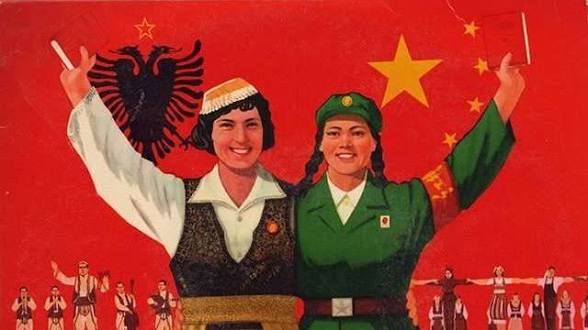

BENJAMIN NULAND argues that although scholars often emphasize shared Stalinist ideology as the foundation of Sino-Albanian cooperation in the 1960s, this ideological alignment functioned largely as a legitimizing factor of the partnership sustained by an intensive propaganda apparatus. In reality, the partnership was driven primarily by material, power, and security interests, most notably Albania’s pursuit of economic assistance and China’s ambition to expand its economic network within the existing communist coalition and to strengthen its political leverage in the Developing World. Ideological alignment was often a nexus of tension between Chinese and Albanians, from conflicting interpretations of the Cultural Revolution to Albania’s refusal to follow China’s strategic line in moments of crisis. Instead of reinforcing cohesion, shared doctrine repeatedly constrained both states’ foreign-policy flexibility and exposed the limits of ideological solidarity as a basis for political alignment.
Introduction
From late April to early May of 1966, Mehmet Shehu and a high-level Albanian Party delegation arrived in Beijing, where, according to the Peking Review, some one million people gathered to welcome them, making it the largest public reception for a foreign state visit in China up to that time.1 Over the course of their meetings with Zhou Enlai and Mao Zedong, the delegation engaged in extensive discussions on the international situation and the future of the socialist movement. The visit culminated in a joint statement denouncing Western imperialism as well as Soviet revisionism under Khrushchev and Brezhnev, extending the critique to Yugoslavia and other Warsaw Pact states.
This visit marked the peak of Sino-Albanian relations. By this point, China had already provided more than 555 million rubles in aid to support Albania’s Third Five-Year Plan (1961–1965), financing major heavy-industry and infrastructure projects that were central to Tirana’s development strategy.2 Yet the significance of the trip extended beyond bilateral ties: it was emblematic of the broader trajectory of the Sino-Soviet split. Beijing sought to assert itself as a pole of Marxist-Leninist thought and to claim leadership among socialist nations as the defender of orthodox Marxism. Albania, isolated within the Eastern Bloc and increasingly hostile to Soviet policy, seized the opportunity to align with China, viewing it as a like-minded partner committed to the preservation of Stalinist principles.3

However, the partnership was fraught with challenges. Practically, the lack of geographical proximity made implementation difficult. China, still reeling from the Great Leap Forward, faced economic strain and domestic instability, making the allocation of scarce resources to a distant ally both costly and politically risky.4 Ideologically, the two countries diverged in their revolutionary experiences. Albania’s largely rural population and minimal domestic opposition contrasted with China’s more complex social composition and internal factionalism within the CCP. These differences shaped their distinct understandings of what constituted an “acceptable” revolution.5 Even in their shared admiration for Stalin, differences persisted. Enver Hoxha of Albania considered himself a faithful disciple of Stalin, having leveraged personal ties with him in 1948 to secure Albania’s sovereignty from Yugoslav influence. The CCP, however, held a more ambivalent view: Stalin’s hesitancy to support the Chinese Communists during the civil war left a complicated legacy. Consequently, Beijing’s endorsement of Stalinism was no more important than substituting it with a new ‘Maoist’ framework.
With these differences in mind, several questions emerge: Why did China and Albania pursue deep engagement with each other despite clear practical and ideological divides? What factors, material and ideological, were the true motivators behind the longevity of an otherwise unlikely partnership? This paper argues that although scholars often emphasize shared Stalinist ideology as the foundation of Sino-Albanian cooperation, this ideological alignment functioned largely as a legitimizing factor of the partnership sustained by an intensive propaganda apparatus. In reality, the partnership was driven primarily by material, power, and security interests, most notably Albania’s pursuit of economic assistance and China’s ambition to expand its economic network within the existing communist coalition and to strengthen its political leverage in the Developing World.
Brief Literature Review
Scholarship on alliances and partnerships during the Cold War generally advances two primary theoretical explanations. Realist theory posits that the international system is fundamentally anarchic, populated by self-interested states competing for power and security. Under this framework, alliances form according to balance-of-power dynamics: states align not on the basis of ideology but in response to shared perceptions of external threats. The greater and more clearly defined the common threat, the more durable and coordinated the resulting partnership is expected to be.6
In contrast, constructivist theory emphasizes that state behavior is shaped by shared identities, norms, and cultural meanings. Partnerships, from this perspective, are grounded not primarily in threat perceptions but in ideational affinities. A subset of this approach, often referred to as principle theory, argues that states possessing a common ideology or institutional orientation are more likely to form alliances, and that shared ideas play a critical role in sustaining cohesion, stability, and effective policy coordination over time. While constructivism does not dismiss the importance of external threats, it maintains that ideological alignment can supersede purely utilitarian calculations of power in producing durable alliances.7
However, recent realists have pushed back against constructivist approaches, arguing that ideology or morality alone does not guide international politics. Instead, they emphasize that national interest and power are the indispensable drivers of state behavior.8 Offensive realists build on this insight, highlighting that the anarchic structure of the international system compels states to maximize power and pursue hegemony for survival.9 In this framework, alliances are formed based on strategic calculations rather than ideological similarity.
Building on this materialist emphasis, some realists argue that morality functions largely as a rhetorical device, invoked to legitimize decisions rooted in power and interest. Ideological alignment, in turn, often operates as a veneer for underlying strategic and economic objectives. Marxist theorists, notably Louis Althusser, reach a parallel conclusion through a different theoretical route that ideology functions to organize social and political relations in the pursuit of material gain and leverage, masking the underlying pursuit of resources and influence behind claims of moral or ideological coherence.10
Chinese-specific IR theories provide a similar nuance to this pushback on Constructivism and Principle Theory. Moral Realist (道义现实主义) scholars such as Yan Xuetong argue that moral authority and ethical leadership can enhance a state’s influence, but morality is ultimately instrumental to achieving strategic objectives.11 This explains why China could frame partnerships with smaller states, like Albania, as morally and ideologically legitimate while prioritizing economic assistance, political leverage, and strategic gain. Complementing this, Relationalism (关系主义理论) emphasizes the hierarchical and status-conscious nature of Chinese foreign policy. Scholars such as John Fairbank highlight that China organizes bilateral ties to maximize material and political benefits, using hierarchy and relational norms as tools to structure interactions effectively.12 Relationalism thus illustrates how China channels its pursuit of concrete material and political interests through hierarchical relationships, with ideological or moral rhetoric serving primarily to legitimize these strategic objectives.
Together, these perspectives offer a robust framework for understanding Sino-Albanian relations, and support the view that the partnership was primarily motivated by material, strategic, and security considerations, with ideology serving as a rhetorical and legitimizing veneer rather than a guiding principle particularly during the Cold War.

Albanian Motivations
Albania’s turn toward China was shaped far less by doctrinal affinity than by immediate security pressures and deep dissatisfaction with its subordinate economic position within the Soviet-led bloc; although propaganda on both sides portrayed the alignment as a union of “orthodox” Marxist-Leninist states, Tirana’s motivations were fundamentally material, driven by its perception of growing Soviet encirclement and by mounting frustration with its marginal role in Moscow’s broader economic system.
1. Strategic Encirclement Created the Search for an Autonomous Security Patron
The most decisive stimulus for Albania’s break with the Soviet Union was its perception of intensifying security vulnerability following Khrushchev’s reconciliation with Tito in the 1955 Belgrade Declaration. The restoration of Soviet–Yugoslav relations reactivated long-standing Albanian concerns regarding Tito’s designs over Kosovo, a territory Albania viewed as integral to its national project and demographic identity.13 The previous split between Belgrade and Moscow had acted as a structural constraint on Yugoslav assertiveness; its removal generated the fear that the USSR might tacitly tolerate, or even indirectly enable, Yugoslav pressure on Albanian sovereignty.
Simultaneously, Moscow’s growing engagement with the Greek Communist Party raised anxieties that Soviet support was emboldening Greek claims over southern Albania.14 Even in the absence of an imminent prospect of direct military confrontation, Albania interpreted these developments as evidence that the USSR was willing, for broader strategic reasons, to sacrifice Albanian security concerns in favor of normalizing relations with neighboring states whose territorial aspirations conflicted with Tirana’s core interests.
This sense of Soviet-enabled encirclement prompted the Party of Labour of Albania (PLA) to seek a protective external partner that could serve as a counterweight without imposing hierarchical oversight. China offered precisely this combination: it possessed sufficient political and symbolic weight to deter Yugoslav and Greek pressures yet was geographically distant and lacked the logistical capacity to exert direct control over Albanian military doctrine or political autonomy. For Tirana, Beijing represented a “large enough” patron to provide leverage against Moscow but a “distant enough” power not to replicate Soviet intrusions. That calculus, not ideological fraternity, made China strategically attractive.
2. Economic Disillusionment with the Soviet System and the Appeal of Chinese Assistance
Albania’s estrangement from the Soviet Union was equally driven by frustration with its constrained position within the Soviet economic framework. Despite initial enthusiasm for socialist development, Albanian leaders grew increasingly dissatisfied with the USSR’s prioritization of agricultural and light-industrial projects.15 While Moscow believed Albania lacked the technological and capital base to sustain rapid industrialization, Tirana viewed these decisions as paternalistic interventions that stunted Albania’s aspirations for heavy-industry development.
Albania also perceived a significant loss of economic autonomy under Soviet guidance. The pervasive presence of Soviet experts limited Albanian control over policy execution, and the perceived preferential treatment of Soviet personnel further exacerbated resentment. COMECON’s division of labor, assigning specific productive roles to member states, was understood in Tirana not as socialist internationalism but as a coercive mechanism that locked Albania into low-value production and exposed it to chronic trade deficits.16 Intra-bloc pricing practices, which set exchange values below international market levels, prevented Albania from leveraging global trade opportunities, including its desired commercial relations with Italy.17
Against this backdrop, China appeared to offer not merely an alternative source of aid but a potentially more egalitarian economic partnership.18 Beijing’s own developmental trajectory, characterized by a centrally planned economy, heavy-industry prioritization, and large-scale collectivization, mirrored Albanian ambitions more closely than Soviet prescriptions did. Albanian leaders inferred from these structural similarities that China would be more willing to support capital-intensive industrial projects and less inclined to impose intrusive technical supervision. This assumption proved consequential: Albania secured China’s largest and longest continuously provided foreign aid program during this period.19 Unlike Soviet assistance, Chinese aid involved more permissive technology-transfer arrangements and prioritized the training of Albanian specialists in China rather than embedding Chinese experts in Albania, an approach that reinforced Albanian autonomy while delivering the material support Tirana sought.20

The Cultural Revolution and the Limits of “Shared” Stalinism
A closer examination of ideological affinity reveals that shared doctrine was not a stabilizing force in the Sino-Albanian relationship but rather a persistent source of friction, especially at the height of China’s Cultural Revolution. At the conceptual level, the two parties diverged fundamentally in their understanding of what a “cultural revolution” entailed. Albania, whose weak bourgeoisie and limited class stratification had enabled Enver Hoxha and the Party of Labor to consolidate power with minimal internal resistance, viewed itself as a mature socialist state that had already eliminated exploitative classes.21 This self-perception sharply contrasted with China’s insistence on continuous class struggle to prevent capitalist restoration, an interpretation rooted in China’s far more complex social composition and factional dynamics within the Chinese Communist Party.22 For Albanian leaders such as Mehmet Shehu, the Chinese notion of an ongoing revolution implied that Albania’s socialist transformation was incomplete, an implication that threatened both Albania’s ideological self-identity and Hoxha’s claim to have carried the socialist revolution to completion.23
These conceptual tensions quickly generated practical disagreements over the purpose, conduct, and applicability of China’s Cultural Revolution to the Albanian context. While Beijing encouraged Albania to emulate elements of the Chinese movement, Tirana rejected the idea that a new revolution was either necessary or desirable.24 Hoxha objected in particular to the role of students and youth groups, rather than workers, as the vanguard of the Chinese campaign, fearing that such a model could produce anarchic outcomes and destabilize party authority.25 He was equally wary of China’s rehabilitations of previously purged figures, such as He Long, which to Albanian leaders signaled ideological inconsistency rather than revolutionary renewal.26 As a result, Tirana adopted a cautious posture: it would not “blindly follow” China unless the Cultural Revolution demonstrably strengthened socialism rather than undermined party control.
These ideological disagreements also intersected with deeper anxieties about leadership, authority, and the symbolic hierarchy of the communist world. Hoxha regarded the growing cult of Mao as a direct challenge to the centrality of Stalin, whose legacy remained the cornerstone of Albania’s political identity. From Tirana’s perspective, China’s ambivalence toward Stalin raised the possibility that Maoism, not Stalinism, would become the new ideological orthodoxy of the international communist movement.27 Such a shift threatened not only Stalin’s position but also Hoxha’s self-fashioning as Stalin’s true ideological heir.28 Consequently, Albania grew increasingly suspicious that China sought to reshape the communist camp around Mao’s image, sidelining both Stalin models, something exacerbated by China’s own ambivalence toward Stalin. Beijing’s partial criticism of Stalin’s “errors” conflicted with Hoxha’s uncompromising Stalinist orthodoxy, deepening distrust and complicating Albania’s willingness to embrace Chinese ideological directives.29
As these ideological frictions accumulated, they began to spill over into the arena of bilateral cooperation, generating tangible strains in the relationship. Albania’s leadership feared that embracing Chinese ideological prescriptions too closely might replicate the pattern of over-dependence on the Soviet Union that Tirana had spent the previous decade trying to escape. The Cultural Revolution thus raised concerns that pro-Chinese factions within the Party of Labor, analogous to the pro-Khrushchev elements of earlier years, could emerge as a domestic threat to Hoxha’s authority.30 Simultaneously, the upheaval in China disrupted the practical foundations of the alliance: Chinese diplomats were recalled for “re-education,” creating a fog of uncertainty around Beijing’s intentions, while Chinese shipments and imports to Albania were temporarily delayed, undermining the continuity of economic relations at precisely the moment Albania depended on them most.31
These factors demonstrate that ideological affinity did not bind China and Albania together; if anything, it exposed deep structural differences in how each state understood socialism, revolutionary transformation, and ideological authority. Far from serving as a source of cohesion, ideology heightened Albania’s sense of vulnerability, sharpened its determination to maintain autonomy from yet another larger communist power, and ultimately contributed to the gradual erosion of Sino-Albanian solidarity.

Chinese Motivations
Despite the geographic distance between the two countries, China did have certain economic incentives to engage with Albania, particularly in the aftermath of the Great Leap Forward. Yet while these material considerations were not insignificant, they cannot by themselves account for the depth or durability of Beijing’s commitment. Economic cooperation between the two states was often inefficient, beset by logistical challenges, and a source of quiet frustration within Chinese leadership circles. However, these frictions never crystallized into overt political tension. Their suppression points to a deeper logic: China’s partnership with Albania was driven less by resource harvest and exchange than by a broader effort to expand Beijing’s economic and political networks within Soviet Satellite Eastern Europe and the Developing World. What appeared outwardly as ideological solidarity thus functioned largely as a legitimizing factor, masking fundamentally material and power-oriented motivations.
Albania did offer certain material resources that China found attractive. Its laterite ore deposits, rich in nickel and iron, appeared valuable at a moment when China, reeling from the disastrous failure of backyard furnaces after the Great Leap Forward, sought reliable inputs for steel production.32 Offshore oil deposits in the Adriatic likewise appealed to Beijing as it searched for alternative energy sources to sustain industrial recovery.33 Yet these potential benefits were consistently undercut by severe practical limitations.34 Many Albanian projects proved unworkable because they required technological capacities China did not possess, particularly in oil extraction. Weak feasibility studies and poor economic planning on the Albanian side further undermined the viability of Chinese-assisted initiatives.35
Labor shortages compounded these challenges. According to Albania’s projections for the Fifth Five-Year Plan (beginning in 1968), completing all Chinese-backed industrial projects would have required an additional 46,000 skilled and unskilled workers, nearly 40 percent of the country’s industrial workforce, far beyond Albania’s means.36 Logistical obstacles such as inadequate port infrastructure and insufficient unloading capacity delayed the transport of industrial equipment.37 Chinese vessels often waited months before offloading cargo, and shipments could take more than a year before becoming operational.38
Behind the veil, economic frictions also surfaced at the political level. Albania sought to sell goods produced with Chinese assistance, such as linen, back to China at inflated prices, prompting complaints within the PRC leadership. Vice Premier Geng Biao’s memorandum to Mao highlighted not only Albanian mismanagement but also the growing strain on Chinese resources. However, these grievances never escalated into open diplomatic conflict, as openly criticizing the “European socialist beacon” risked political consequences.39 Therefore, frustrations were suppressed by Mao and Deng rather than allowed to disrupt the alliance.
The persistence of Sino-Albanian cooperation despite clear economic inefficiencies and limited bilateral returns reveals the deeper strategic logic underpinning Beijing’s engagement. Rather than viewing Albania as a partner in a mutually profitable trade relationship, China treated it as a geopolitical instrument, a stepping stone through which to expand economic networks and political leverage amid growing disillusionment with Soviet economic leadership and the rise of anti-colonial movements across the Developing World. Albania thus mattered to Beijing not for its material productivity, but for its positional utility within broader regional and multilateral structures.
Politically, Albania carried disproportionate strategic value during the height of the Sino-Soviet split. Beijing initially anticipated that widespread Eastern European dissatisfaction with Moscow’s COMECON policies, made visible during the Hungarian Uprising and the Poznań protests of 1956, would generate sympathy for China’s challenge to Soviet financial leadership. Although nearly all Eastern Bloc states ultimately aligned with the USSR, Albania’s defection was uniquely consequential. It demonstrated that China could fracture Soviet authority from within the European socialist camp, directly contesting Moscow’s claims to political and economic primacy.40 Chinese aid to Albania was therefore designed not merely to sustain a friendly regime, but to showcase an alternative socialist development model. Albania, in effect, functioned as China’s de facto representative within Eastern European socialist institutions, even serving as a vocal proxy in the Warsaw Pact until its withdrawal in 1968.41
This strategy for China achieved partial success in courting Romania. Seeking to resist Soviet economic integration and military subordination, Bucharest exploited the Sino-Soviet split to enhance its own bargaining power.42 Sino-Romanian trade expanded rapidly in the early 1960s, with Chinese imports from Romania rising from roughly $2.2 million in 1962 to $27 million by 1965, and Chinese exports increasing from $10.5 million to $22 million over the same period.43 While Romania supported China rhetorically on principles such as state sovereignty and non-interference, it carefully avoided endorsing Beijing’s anti-Soviet polemics. Unlike Albania, Romania framed its engagement with China as a pragmatic assertion of non-aligned socialist autonomy rather than ideological defection.44 Beijing’s appeal through Albania’s proclamations thus succeeded in material terms, through trade and development cooperation, without producing the broader ideological realignment China had hoped for.
Beyond Eastern Europe, China strategically leveraged Albania’s membership in multilateral organizations to advance its economic and political objectives, particularly in Africa.45 Within the Non-Aligned Movement, where China lacked formal membership, Albania acted as an intermediary that projected Maoist anti-imperialist rhetoric alongside tangible demonstrations of Beijing’s developmental capacity. While Albania did not directly mediate Sino-African relations, the diplomatic space it helped cultivate facilitated China’s independent outreach to newly independent African states. The results were material and measurable: Sino-African trade expanded from $34.74 million in 1955 to $250 million by 1965, and China financed the $150 million TAZARA railway linking Tanzania and Zambia, a flagship infrastructure project that signaled Beijing’s willingness to invest heavily in economic cooperation and long-term strategic partnerships with the Developing World.46
Albania’s diplomatic value was equally significant at the United Nations. Beginning in 1960, Tirana consistently introduced annual resolutions calling for the PRC to replace the ROC, culminating in the successful 1971 resolution co-sponsored with Algeria on the principles of territorial integrity and national sovereignty.47 The outcome underscored the effectiveness of China’s coalition-building strategy, where Eastern European states, including the Soviet Union, voted unanimously in favor despite the height of the Sino-Soviet split, while African countries accounted for roughly one-third of the 76 affirmative votes.48 Securing the PRC’s UN seat granted Beijing not only formal recognition, but also permanent membership on the Security Council, including veto power and authority over sanctions and arms embargoes, institutional tools that substantially enhanced China’s capacity to project power internationally.
Therefore, the Sino-Albanian partnership was never primarily about ideological convergence. It reflected a calculated strategy rooted in material, power, and security interests: Albania’s pursuit of economic assistance aligned with China’s broader ambition to expand its economic networks within the communist world and to consolidate political leverage across the Developing World. Albania functioned less as an end in itself than as a strategic platform through which Beijing sought to challenge Soviet dominance and reassert itself as a central actor in the emerging international order.

Ideological Solidarity as Strategic Constraint in the Sino-Albanian Alliance
China initially assumed that Albania’s unwavering adherence to Marxist–Leninist orthodoxy would naturally translate into alignment on core strategic issues. Yet this assumption proved overly optimistic. Beijing repeatedly attempted to leverage shared ideological commitments to secure Albanian support on matters central to China’s security, often with disappointing results.
During the early 1960s Sino-Soviet border clashes, China pressed Albania to endorse Beijing’s territorial claims and denounce Soviet actions as aggression. Tirana refused. Albanian leaders feared that openly confronting Moscow might provoke the USSR to encourage Greek or Yugoslav pressure along Albania’s borders. Hoxha also worried that taking a position on the Sino-Soviet frontier dispute would allow Moscow to frame China and Albania as destabilizers of socialist unity, harming Albania’s reputation within the communist world. In this case, Albania’s security concerns decisively outweighed ideological solidarity and created political tension. Mao expressed this frustration by publicly criticizing Albania’s hesitancy in a 1964 conversation with Japan’s Socialist Party, though Beijing quickly suppressed such remarks to preserve the appearance of unity.49
Paradoxically, the ideological basis of the alliance increasingly constrained China’s strategic flexibility. After Khrushchev’s fall, Beijing explored the possibility of a limited rapprochement with the newly consolidated Brezhnev leadership as a means of softening China’s diplomatic isolation from the Sino-Soviet Split. For this to succeed, China needed Albania, its anti-revisionist ally, to moderate its stance in favor of reengaging with the Soviet Union. Tirana refused, insisting that reconciliation with Moscow violated Marxist–Leninist principles. 50What had once been an asset, the two states’ shared ideological militancy, now impeded China’s ability to recalibrate its foreign policy and soften the international pressure it faced during the split.
This dynamic deepened after the 1968 Warsaw Pact invasion of Czechoslovakia. Both Beijing and Tirana understood the invasion as evidence of the Soviet Union’s willingness to use force against non-compliant socialist states, and Albania feared it might be next. Yet while Tirana sought Chinese military guidance, Beijing instead urged Albania to improve relations with Yugoslavia and Romania to stabilize the Balkan environment.51 Albania rejected this, viewing both states as revisionist.52 Ideological rigidity limited China’s capacity to pursue pragmatic regional de-escalation. What was celebrated publicly as an exemplar of revolutionary unity was increasingly undermined by the tension between ideological orthodoxy and geopolitical necessity. Albania’s strict anti-revisionism, far from providing stable strategic alignment, often constrained China’s diplomatic maneuverability, revealing the contradictions at the heart of a partnership built as much on symbolic commitments as on shared interests.
Conclusion
The Sino-Albanian alliance, long portrayed as a model of shared Stalinist orthodoxy, emerges on closer examination as a relationship sustained not by ideological harmony but by the mutual pursuit of material security and geopolitical advantage. For Albania, alignment with China offered an escape from Soviet domination and a rare opportunity to secure large-scale economic assistance under terms that preserved national autonomy. For China, the partnership provided a European ally through which Beijing could assert political and economic authority, contest Soviet leadership, and broaden its networks within the socialist and developing worlds.
Yet the very ideological framework that propaganda celebrated as the bedrock of the alliance proved neither stabilizing nor structurally coherent. While functioning outwardly as a legitimizing façade, ideological affinity generated persistent friction, from conflicting interpretations of the Cultural Revolution to Albania’s refusal to follow China’s strategic line in moments of crisis. Instead of reinforcing cohesion, shared doctrine repeatedly constrained both states’ foreign-policy flexibility and exposed the limits of ideological solidarity as a basis for political alignment.
Together, the evidence demonstrates that the alliance endured not because Tirana and Beijing were bound by a common revolutionary worldview, but because each found in the other a vehicle for pursuing concrete economic needs and politically-oriented strategic goals. The Sino-Albanian partnership was thus less a unity of ideological conviction than a pragmatic, interest-driven arrangement, one in which ideology served primarily to obscure, not define, the underlying logic of cooperation.
Benjamin M. Nuland (Yale ’27) is a History major focusing on Modern Chinese History and Political Theory. He was born in Shanghai, China, then moved to Princeton New Jersey where he attended High School. At Yale, Benjamin is the Co-Founder and Co-President of the Yale Dialogue on U.S.–China Relations and the Asian Jewish Union, President of Asian Crossroads at Yale, Publisher of the Yale Review of International Studies, and International Collaboration Lead at The Politic. He is also a student leader at the Central Asian Initiative, an undergraduate affiliate of the MacMillan Center’s European Studies Council, a fellow at the Buckley Institute, and an undergraduate head of the 1768 Foundation. Benjamin has previously worked at Target Corporation and the American Chamber of Commerce. Benjamin aspires to join the U.S. State Department, where he hopes to leverage his regional expertise and cross-cultural experience to advance American diplomacy and international cooperation. He may be contacted at: jamin.nuland@yale.edu.
BIBLIOGRAPHY
Althusser, Louis. 1971. “Ideology and Ideological State Apparatuses (Notes towards an Investigation).” Translated by Ben Brewster. In Lenin and Philosophy and Other Essays. Monthly Review Press. https://www.marxists.org/reference/archive/althusser/1970/ideology.htm. Accessed December 17, 2025.
Arkivi Qendror i Shtetit (AQSH), Arkivi i Partise (AP), Fondi 14/AP, Marrëdhëniet me Partinë Komuniste të Kinës (Relations with the Communist Party of China), Tirana, Albania.
Biberaj, Elez. 1986. Albania and China: A Study of an Unequal Alliance. Boulder: Westview Press. (reviewed in Hoare, The China Quarterly 114 (1988): 301.)
Borici, Gjon. 2021. “The Two China Theory and The Stand of Albania 1958–1971.” Academy of Albanian Studies 1: 155–82.
Carr, E. H. 1939. The Twenty Years’ Crisis, 1919–1939: An Introduction to the Study of International Relations. London: Macmillan.
Chou, S. H. 1978. “The Pattern of China’s Trade.” Current History 75, no. 439: 65–90. http://www.jstor.org/stable/45314600. Accessed December 17, 2025.
CIA (Central Intelligence Agency). 1966. “International Trade of Communist China, 1950–65.” October 21. https://www.cia.gov/readingroom/docs/CIA-RDP79T01049A003300110001-2.pdf. Approved for release April 30, 2001.
“Conversation between Hysni Kapo and Kang Sheng in Beijing on 24 January 1967, at 10:00 am.” January 24, 1967. Wilson Center Digital Archive. Arkivi Qendror Shtetëror (Central State Archives, Tirana, Albania), Fondi 14/AP, Marrëdhëniet me Partinë Komuniste të Kinës, V. 1967, Dos. 2, Fl. 1–11. Contributed and translated by Elidor Mëhilli. https://digitalarchive.wilsoncenter.org/document/300032. Accessed April 10, 2025.
“Excerpt from a Conversation between Zhou Enlai and Albanian Party Leaders, 27 June 1966”, June 27, 1966, Wilson Center Digital Archive, Arkivi Qendror Shtetëror (Central State Archives, Tirana, Albania), Fondi 14/AP, Marrëdhëniet me Partinë Komuniste të Kinës, V. 1966, Dos. 13, Fl. 001-130. Contributed and translated by Elidor Mëhilli. https://digitalarchive.wilsoncenter.org/document/300029 Date Accessed: April 18th 2025
Fairbank, John K., et al., eds. 1968. The Chinese World Order: Traditional China’s Foreign Relations. Cambridge, MA: Harvard University Press.
Hoxha, Enver. 1966. “Some Preliminary Ideas about the Chinese Proletarian Cultural Revolution.” Marxists Internet Archive. Last modified 2010. https://www.marxists.org/reference/archive/hoxha/works/1966/10/01.htm#2. Accessed April 21, 2025.
He, Libo (何立波). 2016. “耿飚:将军大使 推动改变援阿政策.” 外交风云 (6): 6–8.
Ionescu, Mihail E. 1982. “Romanian Foreign Policy and the Sino–Soviet Conflict.” East European Quarterly 16, no. 2 (Summer): 179–98.
孔寒冰 (Kong Hanbing) and 张卓 (Zhang Zhao). 2015. “爱尔巴桑记忆——中国援助阿尔巴尼亚专家访谈录.” 当代世界社会主义问题 (Issues of Contemporary World Socialism), Quarterly 1: 79–94.
“Meeting with Comrade Mao Zedong on 5 May 1966.” 1966. Wilson Center Digital Archive. Arkivi Qendror Shtetëror (Central State Archives, Tirana, Albania), Fondi 14/AP, Marrëdhëniet me Partinë Komuniste të Kinës, V. 1966, Dos. 3, Fl. 1–14. Contributed and translated by Elidor Mëhilli. https://digitalarchive.wilsoncenter.org/document/300028. Accessed April 7, 2025.
“Memorandum of Conversation between Chairman Mao Zedong and Comrades Hysni Kapo and Beqir Balluku.” February 3, 1967. Wilson Center Digital Archive. AQSH, F. 14/AP, M-PKK, V. 1967, Dos. 6, Fl. 12–32. Obtained and translated by Elidor Mëhilli. https://digitalarchive.wilsoncenter.org/document/117302. Accessed April 7, 2025.
“Memorandum of Conversation, between the Delegation of the People’s Republic of China, Led by Comrade Zhou Enlai, and the Leadership of the Party and Government of the People’s Republic of Albania [Excerpts].” June 1966. Wilson Center Digital Archive. Central State Archive, Tirana, AQPPSH-MPKK-V. 1966, D. 13. Obtained by Ana Lalaj and translated by Enkel Daljani. https://digitalarchive.wilsoncenter.org/document/117703. Accessed April 7, 2025.
Mëhilli, Elidor. 2018. From Stalin to Mao: Albania and the Socialist World (The Great Leap). Ithaca: Cornell University Press.
Marku, Ylber. 2017. “China and Albania: The Cultural Revolution and Cold War Relations.” Cold War History 17, no. 4: 367–83. https://doi.org/10.1080/14682745.2017.1307179.
Marku, Ylber. 2020. “Communist Relations in Crisis: The End of Soviet–Albanian Relations, and the Sino–Soviet Split, 1960–1961.” International History Review 42, no. 4: 813–32. https://doi.org/10.1080/07075332.2019.1620825.
Marku, Ylber. 2023. “Preparing for an Alliance: China’s Socialist Model and Albania’s Economic Path in the Early Cold War.” European Review of History 30, no. 3: 410–32. https://doi.org/10.1080/13507486.2023.2188581.
Mearsheimer, John J. 2001. The Tragedy of Great Power Politics. New York: W. W. Norton.
Morgenthau, Hans J. 1959. “Alliances in Theory and in Practice.” In Alliance Policy in the Cold War, edited by Arnold Wolfers. Baltimore: Johns Hopkins Press.
People’s Daily (人民日报). 1964, January 6. “在斯库台群众大会上巴卢库第一副主席和周恩来总理的讲话.” 人民日报.
People’s Daily (人民日报). 1967, February 3. “革命战友心连心 高举红旗向前进首都革命红卫兵同阿尔巴尼亚战友联欢…” 人民日报.
“Protocol of the Conversation between Chairman Mao Zedong during the Reception of the Friendship Delegation of the People’s Republic of Albania, Headed by Shefqet Peçi on 18 December 1967.” December 18, 1967. Wilson Center Digital Archive. Arkivi Qendror Shtetëror (Central State Archives, Tirana, Albania), Fondi 14/AP, Marrëdhëniet me Partinë Komuniste të Kinës, V. 1967, Dos. 50, Fl. 2–9. Contributed and translated by Elidor Mëhilli. https://digitalarchive.wilsoncenter.org/document/300035. Accessed April 7, 2025.
“Record of CCP Politburo Discussion related to Peng Zhen, with Corrections by Mao Zedong.” May 13, 1966. Wilson Center Digital Archive. Arkivi Qendror Shtetëror (Central State Archives, Tirana, Albania), Fondi 14/AP, Marrëdhëniet me Partinë Komuniste të Kinës, V. 1966, Dos. 10, Fl. 1–11. Contributed and translated by Elidor Mëhilli. https://digitalarchive.wilsoncenter.org/document/300027. Accessed April 10, 2025.
“Stenographic Note held during the Conversation between Chairman Mao Zedong and Vangjel Moisiu and Myfit Mushi in Shanghai.” August 16, 1967. Wilson Center Digital Archive. AQSH, F. 14/AP, M-PKK, V. 1967, Dos. 47, Fl. 1–8. Obtained and translated by Elidor Mëhilli. https://digitalarchive.wilsoncenter.org/document/117304. Accessed April 18, 2025.
Shanghai Institutes for International Studies. 2013. “Sino–Africa Relationship: Moving to New Strategic Partnership.” 上海国际问题研究院, May 31. http://www.siis.org.cn/Paper/1662.jhtml.
Shen, Zhihua, and Danhui Li. 2011. After Leaning to One Side: China and Its Allies in the Cold War. Washington, DC: Woodrow Wilson Center Press; Stanford: Stanford University Press.
Skendi, Stavro. 2023. “Albania and the Sino–Soviet Conflict.” Foreign Affairs, July 20. https://www.foreignaffairs.com/articles/china/1962-04-01/albania-and-sino-soviet-conflict.
Teodorescu, Bogdan. 2014. “Romania’s Foreign Policy during the Cold War: Between Moscow and Beijing.” Journal of Cold War Studies 16, no. 3 (Summer): 45–78.
UN (United Nations). n.d. “Restoration of the Lawful Rights of the People’s Republic of China in the United Nations.” United Nations. https://digitallibrary.un.org/record/654350. Accessed December 17, 2025.
Xuetong, Yan. 2019. Leadership and the Rise of Great Powers. Princeton: Princeton University Press.
Zhang, Feng. 2020. Chinese Hegemony: Grand Strategy and International Institutions in East Asian History. Stanford: Stanford University Press.
FOOTNOTES
- Hoare, J. E. “Albania and China: A Study of an Unequal Alliance. By Elez Biberaj. [Boulder, Col., and London: Westview Press, 1986. Special Studies in International Relations. 183 Pp. £22·50. Distributed in the U.K. by Wildwood Distribution Services, Unit 3, Lower Farnham Road, Aldershot, Hants. GU12 4DY.” The China Quarterly 114 (1988): 301–301. Web.; Peking Review, May 6, 1966 page 6. ↩︎
- Marku, Y. (2023). Preparing for an alliance: China’s socialist model and Albania’s economic path in the Early Cold War. European Review of History: Revue Européenne d’histoire, 30(3), 410–432. https://doi.org/10.1080/13507486.2023.2188581 ↩︎
- People’s Daily. (1967, February 3). 革命战友心连心 高举红旗向前进首都革命红卫兵同阿尔巴尼亚战友联欢,卡博巴卢库康生叶剑英同志参加巴卢库同志强烈谴责苏修集团镇压我留学生的法西斯罪行. 人民日报 People’s Daily.; All other similar People’s Daily Articles in References ↩︎
- For one, China in early 1962 during the great famine diverted a shipment of Canadian grain to Albania to satisfy its economic support. ↩︎
- “Excerpt from a Conversation between Zhou Enlai and Albanian Party Leaders, 27 June 1966”, June 27, 1966, Wilson Center Digital Archive, Arkivi Qendror Shtetëror (Central State Archives, Tirana, Albania), Fondi 14/AP, Marrëdhëniet me Partinë Komuniste të Kinës, V. 1966, Dos. 13, Fl. 001-130. Contributed and translated by Elidor Mëhilli. https://digitalarchive.wilsoncenter.org/document/300029 Date Accessed: April 18th 2025 ↩︎
- Hans J Morgenthau, “Alliances in Theory and In Practice” in Alliance Policy in the Cold War by Arnold Wolfers (Baltimore Johns Hopkins Press) 1959. ↩︎
- Holsti, Hopman, and Sullivan, “Unity and Disintegration of International Alliances” p 53 ↩︎
- Carr, Edward Hallett. The Twenty Years’ Crisis, 1919-1939: An Introduction to the Study of International Relations. Macmillan, 1939. ↩︎
- Mearsheimer, John J. The Tragedy of Great Power Politics. W.W. Norton, 2001. ↩︎
- Althusser, Louis. “Ideology and Ideological State Apparatuses (Notes towards an Investigation).” Translated by Ben Brewster, Ideology and Ideological State Apparatuses by Louis Althusser 1969-70, Lenin and Philosophy and Other Essays, Monthly Review Press 1971;, http://www.marxists.org/reference/archive/althusser/1970/ideology.htm. Accessed 17 Dec. 2025. ↩︎
- Xuetong, Yan. Leadership and the Rise of Great Powers. Princeton University Press, 2019. ↩︎
- Zhang, F. (2020). Chinese hegemony: Grand strategy and international institutions in East Asian history. Stanford University Press.
Fairbank, John King, et al., editors. The Chinese World Order: Traditional China’s Foreign Relations. Harvard University Press, 1968 ↩︎ - Hoare, J. E. “Albania and China: A Study of an Unequal Alliance. By Elez Biberaj. [Boulder, Col., and London: Westview Press, 1986. Special Studies in International Relations. 183 Pp. £22·50. Distributed in the U.K. by Wildwood Distribution Services, Unit 3, Lower Farnham Road, Aldershot, Hants. GU12 4DY.” The China Quarterly 114 (1988): 301–301. Web.
↩︎ - Skendi, S. (2023, July 20). Albania and the Sino-Soviet conflict. Foreign Affairs. https://www.foreignaffairs.com/articles/china/1962-04-01/albania-and-sino-soviet-conflict ↩︎
- Marku, Y. (2023). Preparing for an alliance: China’s socialist model and Albania’s economic path in the Early Cold War. European Review of History: Revue Européenne d’histoire, 30(3), 410–432. https://doi.org/10.1080/13507486.2023.2188581 ↩︎
- Pula, Globalization Under & After Socialism, 38–40. ↩︎
- Information March 22, 1958, in AQSH, F.14, KNER, V.1958, D.2, f.4–6. (Arkivi Qendror i Shtetit (AQSH)] The Party’s Archive [Arkivi i Partise (AP)) ↩︎
- Ministry of Trade, March 1958, in AQSH, F.503–504, V.1957, D.268. ↩︎
- Marku, Y. (2023). Preparing for an alliance: China’s socialist model and Albania’s economic path in the Early Cold War. European Review of History: Revue Européenne d’histoire, 30(3), 410–432. https://doi.org/10.1080/13507486.2023.2188581 ↩︎
- Tirana, Ministry of Trade, December 3, 1954. Protocol of the Joint Commission for Technical and Scientific Cooperation between Albania and China, in AQSH, F.503–504, V.1954, D.75. ↩︎
- Marku, Y. (2017). China and Albania: the Cultural Revolution and Cold War Relations. Cold War History, 17(4), 367–383. https://doi.org/10.1080/14682745.2017.1307179 ↩︎
- “Meeting with Comrade Mao Zedong on 5 May 1966”, May 5, 1966, Wilson Center Digital Archive, Arkivi Qendror Shtetëror (Central State Archives, Tirana, Albania), Fondi 14/AP, Marrëdhëniet me Partinë Komuniste të Kinës, V. 1966, Dos. 3, Fl. 1-14. Contributed and translated by Elidor Mëhilli. https://digitalarchive.wilsoncenter.org/document/300028 Date Accessed: April 7th 2025; All other Wilson Archives Material Listed in References ↩︎
- Talks between comrade Mehmet Shehu, Hysni Kapo, Zhou Enlai and Chen Yi, 11 May 1966, regarding the divergences on the Joint Communiqué, in AQSH, F.14, AP-MPKK, V.1966, D4. ↩︎
- Mëhilli, E. (2018). From Stalin to Mao: Albania and the Socialist World (The Great Leap). Cornell University Press ↩︎
- AQSH, F.14/AP., OU, V.1966, D21, f.399-401 ↩︎
- Top-Secret, Transcript of the Pla Politburo meeting, 15 February 1967. ‘Report of Comrade Hysni Kapo and Beqir Balluku about their visit in China,’ in AQSH, F14/AP., OU, V.1967, D5, f.21-24 ↩︎
- Hoxha, Reflections on China, 223. ↩︎
- Ibid. p 223-225 ↩︎
- Ibid; AQSH, F.14/AP., OU, V.1966, D21, f.381. ↩︎
- Marku, Y. (2017). China and Albania: the Cultural Revolution and Cold War Relations. Cold War History, 17(4), 367–383. https://doi.org/10.1080/14682745.2017.1307179 ↩︎
- Ibid ↩︎
- 孔 (Kong), 寒冰 (Hanbing), & 张 (Zhang), 卓 (Zhao). (2015). 爱尔巴桑记忆——中国援助阿尔巴尼亚专家访谈录. Issues of Contemporary World Socialism 当代世界社会主义问题, A Quarterly(1), 79–94. ↩︎
- Marku, Y. (2023). Preparing for an alliance: China’s socialist model and Albania’s economic path in the Early Cold War. European Review of History: Revue Européenne d’histoire, 30(3), 410–432. https://doi.org/10.1080/13507486.2023.2188581 ↩︎
- Dokumente Kryesore, 5, pp. 207-208; Pano, The People’s Republic of Albania, p 176-177 ↩︎
- Hoare, J. E. “Albania and China: A Study of an Unequal Alliance. By Elez Biberaj. [Boulder, Col., and London: Westview Press, 1986. Special Studies in International Relations. 183 Pp. £22·50. Distributed in the U.K. by Wildwood Distribution Services, Unit 3, Lower Farnham Road, Aldershot, Hants. GU12 4DY.” The China Quarterly 114 (1988): 301–301. Web. ↩︎
- 何 (He), 立波 (Libo). (2016). 耿飚: 将军大使 推动改变援阿政策. 外交风云, (6期), 6–8. ↩︎
- Marku, Y. (2023). Preparing for an alliance: China’s socialist model and Albania’s economic path in the Early Cold War. European Review of History: Revue Européenne d’histoire, 30(3), 410–432. https://doi.org/10.1080/13507486.2023.2188581
↩︎ - Hoare, J. E. “Albania and China: A Study of an Unequal Alliance. By Elez Biberaj. [Boulder, Col., and London: Westview Press, 1986. Special Studies in International Relations. 183 Pp. £22·50. Distributed in the U.K. by Wildwood Distribution Services, Unit 3, Lower Farnham Road, Aldershot, Hants. GU12 4DY.” The China Quarterly 114 (1988): 301–301. Web. ↩︎
- 何 (He), 立波 (Libo). (2016). 耿飚: 将军大使 推动改变援阿政策. 外交风云, (6期), 6–8. ↩︎
- Shen, Z., & Li, D. (2011). After leaning to one side: China and its allies in the Cold War. Woodrow Wilson Center Press ; Stanford University Press. ↩︎
- 孔 (Kong), 寒冰 (Hanbing), & 张 (Zhang), 卓 (Zhao). (2015). 爱尔巴桑记忆——中国援助阿尔巴尼亚专家访谈录. Issues of Contemporary World Socialism 当代世界社会主义问题, A Quarterly(1), 79–94. ↩︎
- Teodorescu, Bogdan. “Romania’s Foreign Policy during the Cold War: Between Moscow and Beijing.” Journal of Cold War Studies, vol. 16, no. 3, Summer 2014, pp. 45–78. ↩︎
- CIA. “International Trade of Communist China, 1950-65.” Central Intelligence Agency, 21 Oct. 1966. https://www.cia.gov/readingroom/docs/CIA-RDP79T01049A003300110001-2.pdf. Approved for Release on 4/30/2001.
Chou, S. H. “The Pattern of China’s Trade.” Current History, vol. 75, no. 439, 1978, pp. 65–90. JSTOR, http://www.jstor.org/stable/45314600. Accessed 17 Dec. 2025. He mentions an drastic uptick in trade relations from 1960s to 1970s ↩︎ - Ionescu, Mihail E. “Romanian Foreign Policy and the Sino-Soviet Conflict.” East European Quarterly, vol. 16, no. 2, Summer 1982, pp. 179–198. ↩︎
- Ylber Marku (2020) Communist Relations in Crisis: The End of Soviet-Albanian Relations, and the Sino-Soviet Split, 1960–1961, The International History Review, 42:4, 813-832, DOI: 10.1080/07075332.2019.1620825 ↩︎
- Shanghai Institutes for International Studies. “Sino-Africa Relationship: Moving to New Strategic Partnership.” 上海国际问题研究院, 31 May 2013, http://www.siis.org.cn/Paper/1662.jhtml ↩︎
- Borici, Gjon. (2021). The ‘Two China’ Theory and The Stand of Albania 1958-1971. ↩︎
- UN. “Restoration of the Lawful Rights of the People’s Republic of China in the United Nations :” United Nations, United Nations,digitallibrary.un.org/record/654350#:~:text=AgendaA/8501%2093%20Restoration,N%20MALTA. Accessed 17 Dec. 2025. ↩︎
- Hoare, J. E. “Albania and China: A Study of an Unequal Alliance. By Elez Biberaj. [Boulder, Col., and London: Westview Press, 1986. Special Studies in International Relations. 183 Pp. £22·50. Distributed in the U.K. by Wildwood Distribution Services, Unit 3, Lower Farnham Road, Aldershot, Hants. GU12 4DY.” The China Quarterly 114 (1988): 301–301. Web.; Letter of the CC of The Party of Labor and the Government of Albania to the CC of the Communist Party and the Government of China p 29 ↩︎
- Enver Hoxha, Reflections on China vol 1 p 19-20 ↩︎
- Ibid p 419 ↩︎
- Letter of the CC of The Party of Labor and the Government of Albania to the CC of the Communist Party and the Government of China p 38-39 ↩︎